Blog

  • Repurposing Retired Aircraft Carriers

    Repurposing Retired Aircraft Carriers

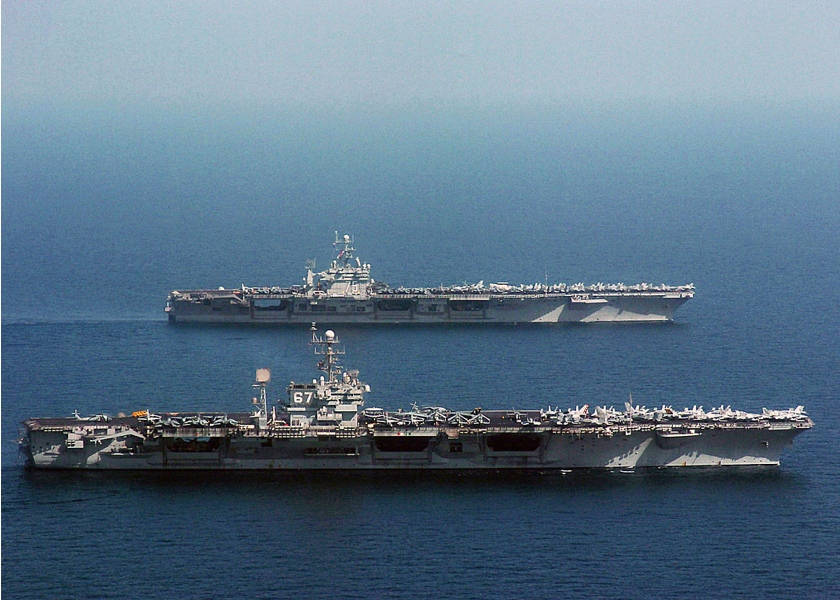
    Advocation: Stop scrapping and start repurposing retired aircraft carriers, other warships, and utility ships with advanced weapons, technologies, and capabilities.

    Security and Incentivizing Ideas: Keep repurposing projects strictly shrouded in mystery for potentially adversarial forces, the press, and unreliable partners as would bleed information. Put the projects under direct military command, strict counterintelligence oversight, and utilize only vetted personnel with no overseas family living in countries in which adversarial forces have significant presence, influence, or leverage. Limit congressional oversight to non-public meetings in secure facilities. Get serious about deterring unnecessary wars and prevent the folly of unnecessary human attrition in our Armed Forces so as to keep force-parity, morale, and recruitment power. Wherever possible, put cleared, vetted, well-treated, well-led military personnel on all technical jobs refitting, repurposing, and upgrading on all projects. Reward service member innovation with innovation education, training, bonus pay, and percentage royalties for produced innovations for as long as innovators stay in the Service, then IP credit references without disclosing specifics on transition to private sector.

    Short Discussion: This topic will be short for security reasons. It is this outlet’s intent to discourage undue bleeding of high quality ideation in open sources on the 5 W’s of repurposing, and the How. In so close a race among major power military buildups with current gray warfare and industrial capacity disparities, there is no excuse for:

    1. Wasting vessels and craft that can be renewed and repurposed faster than new ones can be built;
    2. Failing to use bold and pragmatic imagination for new and old capabilities, producing new parts using new manufacturing capabilities from old drawings and scanned parts;
    3. Failing in boldness to bridge the gap as new vessels and technologies come online;
    4. Failing to resolve objections with ample solutions to those objections given that new manufacturing and shipbuilding capacity requires solutions, not stymied gridlock;
    5. Failing to establish guarded port entries and transportation methods masking the identities of crew members and support staff for the repurposed vessels and craft;
    6. Failing to make the case for special authority under the Defense Production Act and other authorities to fast-track such projects and provide powerful security envelopes around same with strong positive incentives and clearly defined, agreed-to, and memorized security rules with mutual protection in preemptive activation to prevent, not react to risk factors;
    7. Failing to bring honorably retired, transitioned, vetted veterans with special subject matter knowledge back into service to advise and troubleshoot repair, renovation, renewal, and special insights on the potentials of naval assets set for repurposing.

    Preliminary Conclusion

    The objective of repurposing is to effectively adapt to outmatch new warfare modes, potential enemy capabilities, and save time to stand-up new leveraging assets in service to United States defense, security and freedom. Assets lose leverage with PR or press disclosure and or lobbying inquiries or efforts wrongfully given any access to information. Leaks, disclosure, and loose lips must be proscribed completely for defense adaptation to work.

    Note:

    SPC / Strategy Shelf will only respond to verified official contacts from appropriate United States government inquirers into topics of idea research, generation, and critical vetting. SPC anticipates custom security terms to exceed existing legal requirements in establishing what works to keep all consultations, contents, and subject matter secure, undisclosed, and mission-loyal. SPC commits to work with the United States on a results-oriented, proportionate-value compensation basis to establish secure, protected concepts going forward.

  • House Obstruction Drives Risk of Long War, Lost Advantages

    House Obstruction Drives Risk of Long War, Lost Advantages

    The Senate has passed a $95 billion dollar aid package for Ukraine and Israel but the Majority Leader in the U.S. House of Representatives, House Speaker Mike Johnson (R-La.) signaled that Republicans there will not pass it without the border security measures they want.

    However, a bi-partisan border security measure is already on the table that Johnson et al have also rejected, refusing to work across the aisle to mitigate the border crisis now in favor of dictating an approach as a campaign promotion for 2024.

    In a bipartisan realm most Americans yearn for, fair play, not political warfare would win the day. Those in the GOP following Trump’s whims are too afraid of him to reach across the aisle and solve problems now to help unify the country. That fear should be a warning bell. They fear their own candidate or else most Republicans would cross the aisle and pass this bill.

    This state of affairs feeds the Dictators’ Axis daily and increases chances of lost strategic leverage for the United States. This in turns increases chances that U.S. boots on the ground will be necessary to do what Ukraine has been doing to stop the Russians from marching into Eastern Europe.

    Ironically, Johnson and the House majority in deference to Trump by emboldening Putin will likely drive more migration from areas considered next targets of the Dictators’ Axis across the world. With Trump signaling his lack of support for NATO on the campaign trial refugee migration will only get worse.

    If action isn’t taken now, many weaker states and their resources will likely fall to this Dictators’ Axis which will continue working toward its global mercantile guild with which to isolate, reduce trade with, and choke-out the free nations, including the United States. Their goal would be to reverse resource leverage against Americans on behalf of a wave of global dictatorships spreading North, West, and South, surrounding free nations in the West, and the West Pacific.

    If the Putin’s momentum is not stopped as soon as possible, these negative outcomes will unfold with greater speed and momentum as time passes, putting the United States in an isolated, outnumbered position economically, internationally, and militarily. This means the United States could face an Axis of forces with very few friends left to join us in defense against gray, irregular, and kinetic warfare in the decade to come.

  • Jurassic World as Allegory of Dictator Club’s Rise

    Jurassic World as Allegory of Dictator Club’s Rise

    Above: See the video

    Multi Dimension Thinking Needed

    Yesterday I wrote that black and white thinking is not consistent with the United States as a superpower going forward. Today I found a blockbusting cinema illustration of how black and white thinking does not get us ‘Left of Bang’ or in the movie’s case, ‘Left of Fang.’

    The iconic Jurassic World scene contains a rough analogy to a situation the United States leadership finds itself in today as reengineered 20th Century threats rise in the new millennia.

    The dinosaurs of the Dictators’ Club have breached the containment of last century and returned with new tech to become Alphas for a group of velociraptors once called rogue states and terrorist groups. This, in a bid to make this a Jurassic World if they can.

    In the movie, Jurassic World employee Barry (Omar Sy) says to leading man Owen (Chris Pratt), “Something’s wrong. They’re communicating.” To which the dino-whisperer Owen intones with noise discipline, “I know why they wouldn’t tell us what it’s made of…that thing’s part raptor.” Both are heavily armed and told “Light ’em up!” Whoops, the lethal Dinos scatter into their milieu to become the hunters.

    In the real world today, it is worse than that. The Dictators’ Club dinosaurs are communicating through us politically, as if part of us, influencing our perception of each other. They are using information triggers, algorithms, psychological manipulation of emotional thresholds, blind internet echo chambers, and coercive threats to take advantage of Americans’ dichotomous thinking habits developed in part as a defense mechanism to information overload. The agitative spell has too many Americans barking like raptors in thrall to alpha leaders, ready even to attack each other at their command. Is that freedom?

    How Black and White Thinking Developed in Nixon’s China Engagement

    Flirtation with authoritarian fiat goes back some time to longtime Trump advisor Roger Stone’s first political love, Richard Nixon, whose bust is tattooed on Stone’s back and whose image covers his walls.  

    Nixon implied a disregard for Democrat fellow Americans in favor of a close relationship to Chinese dictator Mao Zedong in their February 21, 1972 first meeting. There, Kissinger also told Mao that the American left was pro-Soviet, impliedly bifurcating dual U.S. party loyalties to two dictatorships. What could go wrong?

    Kissinger’s was a sort of black and white thinking during the Cold War which ultimately led to a deep industrial and defense supply chain entanglement with authoritarian, communist China. Today, this black and white strategy of playing Russia and China off of each other clearly did not seriously address what would happen if China and Russia began working together against U.S. security, defense, and freedom.

    Consider the nuances of Nixon’s and Kissinger’s interchanges with Mao as seem to have got the long march to U.S. industrial dependence started:

    Chairman Mao: It would be very dangerous if you have such a candidate. But let us speak the truth. As for the Democratic Party, if they come into office again, we cannot avoid contacting them.

    President Nixon: We understand. We will hope that we don’t give you that problem.

    Chairman Mao: Those questions are not questions to be discussed in my place. They should be discussed with the Premier. I discuss the philosophical questions. That is to say, I voted for you during your election. There is an American here called Mr. Frank Coe, and he wrote an article precisely at the time when your country was in havoc, during your last electoral campaign. He said you were going to be elected President. I appreciated that article very much. But now he is against the visit.

    President Nixon: When the President says he voted for me, he voted for the lesser of two evils.

    Chairman Mao: I like rightists. People say you are rightists, that the Republican Party is to the right, that Prime Minister Heath is also to the right.

    President Nixon: And General DeGaulle.

    Chairman Mao: DeGaulle is a different question. They also say the Christian Democratic Party of West Germany is also to the right. I am comparatively happy when these people on the right come into power.

    President Nixon: I think the important thing to note is that in America, at least at this time, those on the right can do what those on the left talk about.

    Dr. Kissinger: There is another point, Mr. President. Those on the left are pro-Soviet and would not encourage a move toward the People’s Republic, and in fact criticize you on those grounds.

    Chairman Mao: Exactly that. Some are opposing you. In our country also there is a reactionary group which is opposed to our contact with you. The result was that they got on an airplane and fled abroad.

    Note also at the link Nixon’s promise to Mao that the meeting’s communications would be kept a secret. Does this sound familiar? The existence of tapes, letters, and communications of dictators and officials inveigling a U.S. president’s agreement with authoritarian sentiments and power plays?

    Nixon’s boast that “those on the right can do what those on the left talk about,” prompted Mao to respond that Democrats opposing Nixon’s move toward China were like Chinese “reactionaries” whose opposition to Mao’s meeting Nixon resulted in their exile. This was Mao’s suggestion that Nixon should consider treating the Democrats similarly, adopting China’s way.

    Not only Republicans snuggled up to foreign dictators for political points. To try to discredit Romney-Ryan in 2012, Obama-Clinton publicly accused Mitt Romney of being stuck in the Cold War for calling Putin’s Russia a threat. Obama-Clinton was in agreement with Dmitri Medvedev who said the same. And yet Romney was right all along. Indeed, it was Putin’s unaccountable nation state soft-money that helped Donald Trump beat Clinton in 2016.

    Where We Are Now

    The U.S. GWOT and seemingly compelled trust in the long-developed U.S. economic entanglement with China led to U.S. blindness and dependence on Chinese manufacturing, atrophying the U.S. defense-industrial base, with adverse effects on U.S. capabilities as set forth in this report.

    Russia and China are not only communicating among themselves, but working together in communicating with proxies much as the alpha dinosaur directs smaller predators in the Jurassic World clip above.

    China and Russia have also influenced, hacked, and compromised both U.S. parties on the right and left, partisan media firms, non-profits, software, hardware, and political families over time.

    With black and white thinking the United States had in the 1990s disregarded Russia or China as serious threats and focused instead on so-called “rogue states” until 2000, shifting after 9-11 to the global war on terror (GWOT).

    Like a smoke ring in the jet stream, vigilance against near peer dictatorships had nearly dissipated during the 1990s and GWOT, and the United States lost perspective on its missions, exit strategies, and Weinberger-Powell Doctrine rules.

    The U.S. is now playing a catch-up game to secure itself as a unified nation and superpower  facing aggressive gray and kinetic warring activity by China, Russia, Iran, Russian PMCs, Chinese maritime militias, smaller dictatorships, terrorist organizations, and criminal proxies. China and Russia use extremists and fringe political actors to harass, drain, distract, and divide Americans, including those in the Armed Forces, the IC, state, and local governments. To divide and conquer is their goal.

    Creative Statesmanship and Innovative Adaptation Are Key

    The United States in adjusting slowly, however, has undertaken workarounds for its deficits that involve innovations in technology, adaptation of strategy, tactics, and use of instruments of power to keep a deterrent balance of power with the rising dictatorships of the East.

    To succeed in this renewal project requires principled domestic leadership, creative statesmanship and innovative defense-industrial adaptation. It requires ramped-up domestic investment in production capability across the nation and mutual trade arrangements with allies to cover joint needs.

    U.S. national unity calls for creative, effortful ways of thinking effectively and accomplishing good goals together. This relies on changing American minds to engage in multidimensional thinking, relating, listening, speaking, investigating reality, learning, curiosity, fact finding, empathy, honesty, and enterprising action. Black and white thinking and feeling will not suffice to bring the country to a youthful state of growth and esprit d’ corps.

    E Pluribus Unum and In God We Trust should both remain important mottos for Americans working in common interest. In our best times, both faith and reason, courage of heart and science in practice, and endurance for the long race together have proven sound bases for keeping our living Republic in its constitutional, republican, and representative democratic hues. 

  • A Colorful Cosmos Favors Creative Statesmanship Over Black and White Thinking

    A Colorful Cosmos Favors Creative Statesmanship Over Black and White Thinking

    Black and white thinking is inconsistent with the United States as a superpower with a future. Reality is waveform and continuous, not a black and white still-life.

    As in viewing features on a landscape and noting linear patterns that almost always give away human activity, so black and white choices before us suggest likely erroneous human preparation of choices for decision makers, voters, office holders, lawmakers, and military leaders. This, instead of choices discovered through and despite the appearance of dichotomized futures.

    Often, ‘Black and white’ choices are false dichotomies presented as necessary or inevitable when they are not. Not because one of two of the choices or values represented are necessarily wrong or don’t exist, but for falsely assuming they are the only choices. There are often custom, alternate options to discover or create.

    However, limits in time and resources can pressure thinking toward the black and white dichotomy. Sometimes human intent or negligence unethically or immorally invites the pressure.

    Morals, ethics, and honor codes are not black and white thinking, however, they tend to be black and white rules, guides, and blazes aiding navigation to realistic values in international and domestic human relations, political, diplomatic, or otherwise.

    After morals and ethics help preserve national unity behind war, peace, defense, deterrence, irregular warfare, security, and the like, simplifying the nation’s position, chances for whole of nation cohesion improve. Simplicity invites new complexity as human beings seek new solutions. Complexity arises from simplicity, and simplicity from complexity in a waveform existence.

    Who we are as a unified nation matters, however, we must not assume ourselves the rightful influencers wherever we go in the world. We should be made of superpower stuff regardless, but not poison our unity, military cohesion, and international legitimacy with imperial premises, talk, or behavior.

    Black and white thinking about black and white rules and guidelines, even moral and ethical ones, is how the reference points can become means of self-destruction and that of others. Wisdom calls for living behavioral principles guiding the powerful to rightly handle black and white morals, ethics, and codes of honor past, present, and future in the spirit of the laws.

    Handling these ambiguities and complexities is a roller coaster ride through reality in its waveform. Harmony between mercy and judgement, carrots and sticks, and with strong solutions of war’s causes will re-establish leadership and statesmanship in United States governance of its superpower without the self-administered poison that is the hubris of empire.

  • Blockade the Houthi Blockade

    Blockade the Houthi Blockade

    Photo credit CC License: Ferdinand Reus from Arnhem, Holland.

    Situation

    The Houthis of Yemen have bombarded Red Sea commercial shipping against Western interests using the Iran regime’s funds, arms, training, and equipment with indirect benefit and support to Beijing and Moscow, whose Red Sea traffic is exempt from Houthi fires and Iranian harassment.

    Naval and air strikes alone cannot stop the Houthi militants. Some say ‘boots on the ground’ are the only way to assert control. Yet that is not wise or feasible and would certainly fail the Powell Doctrine for the wise use of military force given U.S. interests in the current milieu.

    Possible Option: Lethal Aid Blockade

    While the Houthis aim to blockade the Red Sea by force, their blockade might force an international blockade of the Houthi territories in Yemen different in character from the Saudi Arabian blockade of seven years ago. A lethal-aid blockade of Houthi controlled territory could work if enforced by the Prosperity Guardian coalition members screening shipments for weapons and munitions headed to Yemeni ports, while letting food, humanitarian, and civilian aid in.

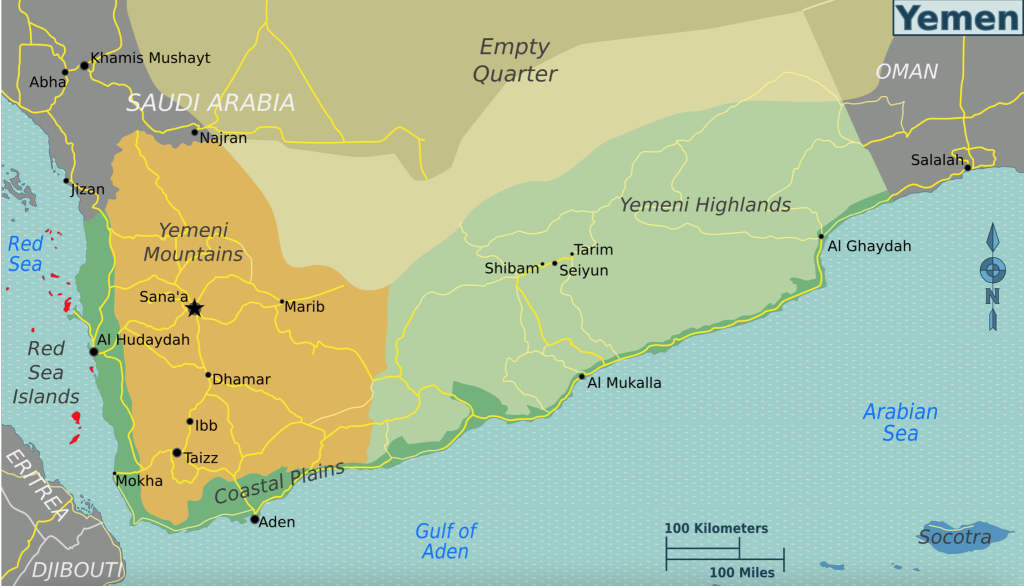
    Over the midterm, such a blockade could deprive Houthi militants of weapons and ammunition by air, land, and sea until a Red Sea security deal is worked out with or without them. Yemen borders Saudi Arabia, Oman, and two Seas, however, the golden area shown below marks the Yemeni highlands including the capitol of Sana’a, where the Houthis control. It is a less ambitious area to cover than all of Yemen.

    Lethal aid screening of cargo flights to Yemen would imply cooperation of governments in nations of origin and connection. However, cargo flights from non-cooperating governments imply interception, diversion and screening at coalition or cooperating governments’ airfields.

    The Saudis blockaded Yemen while intervening in the Yemeni civil war after 2015. The Saudi blockade cut-off humanitarian and food aid from Hudaydah and other Yemeni ports. Humanitarian blockades imposing hunger and starvation on civilians are morally wrong and counterproductive. Moral authority is key to earned influence and leadership. It also goes to mutuality and comity in international relations.

    Intelligence Objectives and Humanitarian Workarounds Planned in Advance

    Intelligence objectives in support of the blockade should document for UN presentation any Houthi militant interception and deprivation of civilian humanitarian and food aid to the Yemeni population.

    Should Houthi militants impose hunger and starvation on Yemeni populations as an information war tactic, then coalition supply balloons, air lifts, drones, and screened Red Crescent shipments of humanitarian aid could bypass Houthi militants and directly supply Houthi communities while winning hearts and minds and turning the population against the militants.

    Reversing Iranian Terror and War Sponsorship

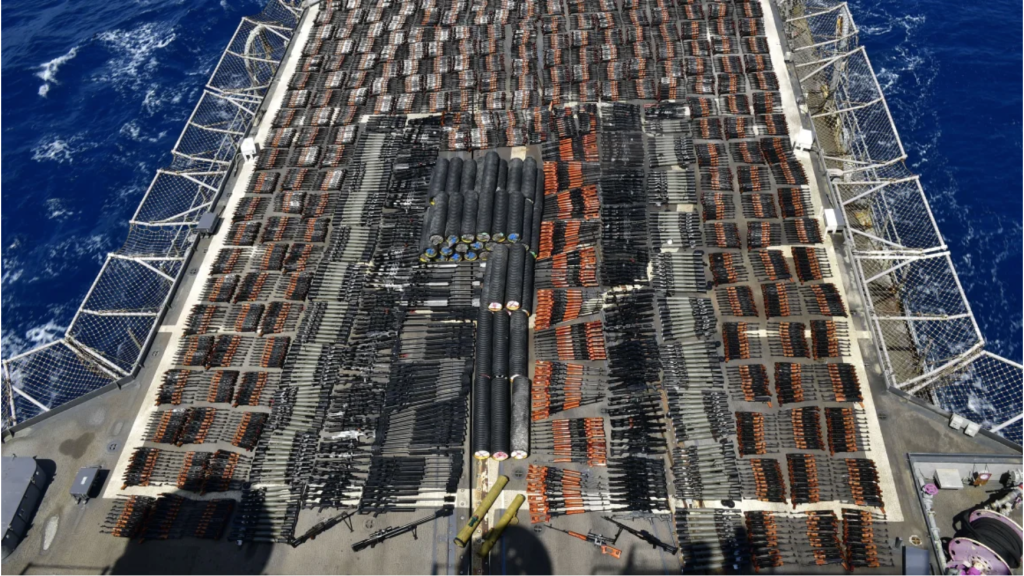
    Seized weapons and ammunition headed for the Houthis should be set aside for the Iranian resistance to the dictatorial, revolutionary regime parasitizing Iran and the region with perpetually sponsored regional violence and destabilization. Still, beware of sabotaged shipments to prevent loss of sailors.

    US NAVY photo. Seized Iranian weapons shipment.

    Beneficiary Shipping Nations’ Contribution to Blockade and Humanitarian Operations

    Nations and entities benefitting from a cessation of Houthi militant attacks on Red Sea shipping not part of the Prosperity Guardian coalition should contribute financially to the costs to governments sponsoring the blockade as reduces the Houthi threat to make Red Sea shipping economical.

    Iranian Contingencies

    Possible attacks from Iranian forces on coalition navies blockading the Houthi militants would require a contingency plan for ending same. What that is exactly should not be telegraphed, but should be decisive in wiping out Iran’s missile, drone, marine militia, nuclear development, satellite launch, defense industry, and naval capabilities across the Middle East.

  • Defusing Swarm-Escalation with Robotic Working Craft

    Defusing Swarm-Escalation with Robotic Working Craft

    Setup:

    China’s maritime militia is causing chaos to make a point that everyone gets already: Xi Jinping does not want China humiliated. It uses armed vessel swarms, water cannons, intimidation, ramming, and brinksmanship backed-up by PLA Navy’s terraformed military bases, coast guard, and PLAN assets to assert dominion over the entire South China Sea (SCS or the Sea).

    Beijing’s maritime militia risks escalation, and could provoke responses China might use as a pretext for conquest of other nations’ claims, waters, or territory. We know this and China knows we know this.

    It is not the United States’ or trading partners’ aim to humiliate, dominate, or colonize Asia. Trade, travel , mutually profit, and share excellent international experiences with? Yes, although we seem to have failed to convince the Chinese imperial court of Xi Jinping of that and so must consider the following.

    The swarming force of China’s large numbers of vessels multiplied by their known and unknown capabilities overwhelms civilian, coast guard, and navy assets of SCS nations and freely navigating trading nations. The numeric disadvantages of smaller SCS nations negatively impact their ability to maintain presence to claim freedom of navigation, lawful uses, territorial and or Exclusive Economic Zone EEZ rights.

    Checking the Chaos: Fleets of Robotic Craft on Legitimate Civilian Missions

    Smaller SCS nations face enough climatic, resource, food, and ecological problems in their bounding seas to justify unmanned remote human-controlled civilian missions using flagged robotic craft for research, conservation, coast guard, and emergency services. The word “craft” implies smaller maritime assets with numerosity, coordination, agility, and more options.

    More robotic civilian mission craft could positively impact the health of the Sea’s marine life, trade, and human ecosystems. This civilian emphasis could help reduce the destabilizing military overemphases that creates more SCS problems than it could hope to fix.

    Meanwhile, SCS nations showing their value in the maintenance of the health of the SCS as a community of contributing SCS nations can support their reasonable and lawful claims in the SCS whether in their claimed EEZs, international waters, and or in lawful navigation of the greater Sea.

    A necessity pressuring some compromises: Marine life populations and their ecosystems are future food source investments to all in the SCS region including China. SCS wildlife and ecosystems do not care about EEZs, 9-dash lines, or human ambitions. They march to rhythms and cadences of tides, undersea activity, and migration that speak to the long game of their own survival, and relatedly, human survival on Earth.

    Civilian missions to bolster these ecosystems by any and all SCS participants can help create a system of checks and balances on any one single-power’s dominant control over scientific information about the Sea’s natural bounties, ecological health, climatic factors, and problems.

    The six civilian missions in bold below are a non-exhaustive list of missions benefitting SCS nations.

    Science: Such robotic craft serving scientific missions could include surface and subsurface fleets of human remote-controlled unmanned craft or vehicles serving the biological, ecological, climatic, resource, seismic, geologic, and other SCS ocean science needs for SCS-bounding and using nation states. In addition to China, the Philippines, Vietnam, Malaysia, Japan, South Korea, Taiwan, Brunei, and freely navigating trading nations have a stake in maintaining scientific currency on the state and health of the SCS. Findings and data may be shareable with other SCS nations including China. Conservation efforts everywhere can benefit those everywhere else, and coordination is a positive.

    Conservation: Conservationist missions could utilize manned and sometimes unmanned craft for clean-up, habitat restoration, species surveillance, monitoring of seaborne and underwater activities affecting fish stocks, marine ecology, and pollution levels in the SCS.

    Serving Coast Guard Search, Rescue, Aid Delivery, and Interdiction of Contraband: Coast guard missions by SCS states are self-explanatory to include search, rescue, aid to boaters, aids to navigation, and interdiction of illegal contraband. Those traditional missions are most often manned, however, use of robotic semi-autonomous or remote controlled craft could expand some capabilities at lower cost than those supporting human crews. SCS nations, rather than seeing their coast guards nearly spark wars every few days on the open sea, could become more productive cooperators in coast guard joint operations in disputed areas, and when necessary, if a nation cannot cover its own waters in time due to extenuating circumstances aid each other’s missions inside territorial waters.

    Anti-Piracy Operations: SCS state naval forces and SCS trading nation navies could also use remote-controlled or semi-autonomous craft to help enforce piracy laws and defend territories and peoples in the SCS region, a prerogative nearly all international navies possess.

    Freedom of Navigation Operations (FONOPS): Traditionally done with manned naval assets, this mission could be augmented with remote, unmanned yet human-controlled, flagged watercraft. The same is true for SCS nation navies and coast guard craft whether manned or unmanned, yet human controlled. The robotic craft could be properly registered for global navigation purposes.

    Unmanned Craft Escorts: The unmanned craft might also provide area denial escort capabilities for boats, vessels, and other craft harassed on the SCS forcing unofficial vessels conducting unsafe maneuvers to keep safe distance from escorted vessels, or even official vessels conducting excessive force or lethal force in violation of international law.

    Communications: Unmanned craft might also serve as alternative communication and monitoring craft, serving overwater and underwater communications, repair, and replenishment needs.

    Deterring Close Calls Helps Promote Peace

    Free nation use of robotic craft for various missions in the SCS could enable considerably broader coverage of the Sea while at times coming together in swarms themselves to break-up and create distances between risky, unsafe nationalistic behaviors among vessels. Deterring close-calls would help reduce risk of manned vessel collisions, hostilities, and or combat.

    Nature of the Craft

    Flagged, unmanned, human-controlled craft need not be large and can be designed so they are hard to capture, break, move, destroy, sink, intimidate, vandalize, get around, hack, or otherwise control without detection. Moreover, the craft could have internal self-destruct capabilities.

    Sensors, cameras, software, data gathering, or payloads on robotic craft need not be expensive or complex, but if necessary could be. It depends on the craft’s mission and on applications the craft may have. The simpler the facility onboard, the less can go wrong. The simpler, the more craft can be deployed for lower costs, for example. More craft means more combinations, angles, potentials, and mass effects.

    Without going into specifics of types, designs, and capabilities these robotic craft could have, it is enough to know that large numbers of such craft could make it much harder for  maritime militias or pirates to swarm or approach manned craft in unsafe ways without colliding with these utility craft escorts, for example. This would reduce the likelihood of firefights between manned vessels.

    Nor do the craft have to all be of the same design or size given their multipurpose use potential. Today they may study the ecology of the SCS, and tomorrow help replenish or evacuate the crew of a vessel compromised by a strong storm. Or the next week, recover cargo lost by a container ship. The uses are adaptable, and that can make the SCS a more productive realm for all.
  • China’s Strategic Buffering and Iran

    China’s Strategic Buffering and Iran

    Yesterday, Britain, France, and Germany asserted that Iran has violated a U.N. Resolution buttressing the Joint Comprehensive Plan of Action (JCPOA) by “developing and testing ballistic missiles, transferring hundreds of drones to Russia, and enriching uranium to an unprecedented 60% level for a country without a nuclear weapons program — all in violation of a U.N. resolution endorsing the deal.”

    Background

    Mainland China once enabled proliferation of nuclear weapons technology to Pakistan and North Korea as a deterrent buffer against India, South Korea, Japan, and the United States. China has been trying to do the same through its sovereign firms to make energy buffers of Iran and Saudi Arabia for its Belt and Road expansion.

    A 2020 U.S.-China Economic and Security Review Commission study by Will Green and Taylore Roth reported that the U.S. State Department had sanctioned China’s sovereign company Wuhan Sanjiang Export and Import Co. Ltd. for selling technologies for Iran’s military in 2017 and in 2020 in violation of the Iran, North Korea, and Syria Nonproliferation Act, adding:

    The Chinese government also has turned a blind eye to the proliferation of technologies that according to the U.S. Department of Justice, “could be used in the production of weapons of mass destruction and/or devices used to deliver weapons of mass destruction.”

    And a Jan. 23, 2023, a Congressional Research Service report on Chinese Nuclear and Missile Proliferation reported that the Chinese government has played a shell game in claiming to cease direct nuclear and missile technology transfers to Iran and North Korea while shifting the practice to China’s sovereign-owned entities.

    Upshot

    In view of the above it appears China, with Russia’s help intends to proliferate nuclear weapons capability to autocratic Middle Eastern energy states to make them loyal energy buffers for China while coopting their autocratic regimes in alignment against Israel and the United States via the Hamas provocation. Russia is China’s other energy buffer state, a strategic and violent influencer over OPEC, co-proxy with Iran, and a war making gray state dividing the free nations and their alliances by subversion, lying diplomacy, and force. These military moves support the Belt and Road which in turn is intended to be a multiplier of China’s instruments of power.

  • Argument: Iran’s Theocratic Regime is No Longer a Legitimate Nation State Government

    Argument: Iran’s Theocratic Regime is No Longer a Legitimate Nation State Government

    Argument: The theocratic dictatorship of Iran is so deeply involved in terror sponsorship, principal-agent terror relationships, terrorist proxy supply, and destabilization activities adversely affecting other legitimate nation states that it can no longer be considered a legitimate nation state government itself. Iran rather fits the description of a terrorist organization occupying a former nation state’s governing assets that it uses for terror against its own people and people abroad. Iran has also added to civil war and or failed state statuses of Afghanistan, Yemen, Syria, and is threatening to turn Iraq into a failed state. Likewise, Iran has militarily supplied Russia’s war of aggression against Ukraine and its drones used in terror attacks on Ukrainian civilians.

    For reference, here is a report on Iran’s terror networks and support by United States Institute of Peace through 2021, citing State Department reports.

    In December 2023, see the update on Iranian-resourced activity in addition to the massive Hamas attack, hostage taking, and commission of war crimes against Israel and Israel civilians:

    “Iranian proxies have launched more than 90 attacks against U.S. forces since October 17th, 10 days after the Hamas terror attack on Israel.”

    Further Remedies for Islamist Terror Organization’s Occupation of Iran’s Government:

    (1) The Senate should follow suit with the House’s passage of the “No Funds For Iranian Terrorism Act” freezing the 6 Billion USD transfer approved by the Biden Administration in exchange for Iranian release of 5 hostages.

    (2) Exclusion of the theocratic terror organization occupying Iran’s U.N. seat from the U.N. and all rights pertaining to nation state status at and through the U.N., and replacement by a legitimate, exiled Iranian delegation to represent occupied Iran at the U.N.;

    (3) Multinational invocation of the International Convention for the Suppression of Terrorist Bombing as applicable to the theocratic terrorist organization occupying the seat of government over modern Iran and relevant enforcement activities against the terror organization’s activities supporting terrorist attacks and wars of aggression on civilians, other states, shipping, and military vessels in international waters;

    (4) Nation states and stateless peoples adversely affected by the terrorist organization’s use of Iran’s assets to foment terror such as Israel, Saudi Arabia, Lebanon, the United States, and multiple nation states whose flagged vessels are attacked by Iranian terror proxies or agents in the seas of the Middle East could take collective military, diplomatic, law enforcement, economic, financial, informational, psychological, cyber, and intelligence action against the terror organization controlling Iran’s government to end its reign of terror.

  • Strategic Patterns: China & Russia Seek Control Over Food & Migration

    Strategic Patterns: China & Russia Seek Control Over Food & Migration

    Setup

    There is a common strategic pattern in China’s pursuit of global food supply control at-Sea, international agricultural ownership, and support for Russia as it guns for Ukraine as Europe’s breadbasket.

    China also supports Russia as Moscow asserts its “plus” influence on OPEC, towards inflating fuel and therefore food prices in many markets. China also supports Russia as it selects, subverts, and supports incompetent, corrupt leaders that vandalize their own vassal economies as seen in Venezuela and Lebanon.

    With its global real estate investments China can enhance its cash flow and food security related to domestic needs (semi-benign) or use coercive supply side controls (unrestricted warfare) as an aspect of the “Belt” in the Belt and Road (BRI). Both benign and malign uses of food control could be strategic, with greater risk for all, including China, in the latter.

    From the strategic malign perspective, the Belt, with Russia’s help is cinched around the Global South’s girth, and tightened through the loops of corrupt vassal dictatorships until oppressed or disfavored millions are forced to flee their homes. Many flee to the Global North for help: the United States, Canada, European Union, U.K., and Nordic countries. As such, the dictators’ club seems to be saying: Let the free world fight with itself over receiving the huddled masses while the dictators build, produce, and expand.

    “The Road” would be China’s buildout of imperial, mercantile infrastructure projects, ports, businesses, military bases, and the export of Chinese expats throughout the world to collect resources and perpetuate Xi’s global Empire. For Russia it would be trade partnerships with Russian energy (oil and nuclear), arms, space, and private military services for sale.

    With the poor and problematic out of the way and off of vassal states’ socialist debt ledgers, China, Russia, and their vassal leaders could more easily seize abandoned land and industrialize the outposts of the new Chinese and Russian empires at lower cost.

    Famine, Hunger, Militant Coercion, and Weaponized Migration

    Does the above seem too harsh an analysis? History suggests otherwise. Stalin and Mao used violence, famine, and hunger as weapons to consolidate power and clear out entire populations protesting their communist dictates, evidenced in their 20th Century democides, the Holomodor of Ukraine and the Great Chinese Famine.

    Fast-forward. On June 6, 2023, Putin’s invading army flooded a vast swath of Ukrainian agricultural land by blowing up the Kakhovka Dam with dire humanitarian impact while retreating from Ukraine’s early counteroffensive to Russia’s February 2022 aggression. Putin also ordered Black Sea blockades on marine shipments of Ukrainian grain to Africa and other famine-sensitive markets, agreed to lower it, then reneged and bombarded a Ukrainian grain facility in Odessa.

    Putin would do this, you think. He is a heartless KGB agent of Soviet origin. A nihilist like Stalin. But Chinese President Xi Jinping? He speaks at Davos, invests abroad, lifts Chinese from poverty, wears a Western suit, and brokers common ground between Sunnis and Shiites. How could he have used food as a weapon? By supporting Putin as he drives conflict, chaos, displacement of people in Latin American, Africa, and the Middle East via Wagner Group violence and inflationary OPEC influence.

    Other than letting Russia do his direct dirty work, Xi’s use of food and poverty as a weapon occurs with “Distant Water Fishing” or DWF, which China does globally on a massive industrial scale, including in fisheries off the coasts of Latin America and Africa, adversely affecting local fish stocks and fish industries.

    One may mistake China’s DWF fleets with an estimated 17,000 vessels globally (per Ocean Development Institute) as hard-nosed business competition until you realize the industry has been subsidized by the Chinese communist government since the fleets’ deployment. And China is rated as by far the greatest global perpetrator of illegal, unregulated and unreported (IUU fishing) in the world.

    Unchecked, overfishing of Latin American and African coastal fisheries by industrial scale Chinese DWF operations has and will continue to have a negative economic impact on artisan and advanced artisan fishers from Latin American and African coastal communities dependent on sustainable marine life ecosystems for their livelihoods and food supply. One study found distant water fishing off the West African coast caused “loss of revenues for Mauritania, Senegal, The Gambia, Guinea Bissau, Guinea, and Sierra Leone, estimated at 2.3 billion USD annually.”

    What does loss of livelihood do to coastal dwelling fishers one might call artisan, subsistence fishermen, or to larger advanced artisan fishing operations? Here’s just one human interest quote:

    “Imagine working for weeks and not being able to catch food,” says Woody Backie Koroma of the Sierra Leone Artisanal Fishermen Union. “They are getting debts. They go to bed without food.”

    Such is the strain, says Koroma, that one debt-ridden fisherman in Tombo killed himself last year after his boat was confiscated by the local authorities.

    The large scale risk is collapse of fish stocks, extinction of species links in food chain, and breaking of regenerative ecosystems coastal communities and their markets depend on. If that happens, multiply the human interest story above by some tens of millions, with repeat refugee disasters hitting humankind.

    With China financing infrastructure and agriculture in many of these developing countries, few of their leaders protest China’s overfishing DWF fleets. Kenya, for example suffered a drop in their local fishing catches but opted not to ban Chinese goods in retaliation for China’s DWF off of Kenya.

    China’s DWF fishing puts China in a position either to become an economic savior and food supplier to nations it has ‘fished-under,’ or the angel of death. Consider China’s subsidized aqua-culture industry aimed at mass fish production as a backup should it hollow out the oceans’ fisheries. It has also been developing aquaculture vessels to solve problems with land-based aquaculture and bring a mobile aspect to fish production and sales abroad. It is a cynical implication, but real nonetheless.

    If China’s overfishing drives fishing-dependent citizens out of developing coastal states, where do they go? From Africa they go to the European Union and in Latin America, increasingly to other Latin American states or to the United States. Abandoned coastal towns and fewer poor for the vassals to subsidize would make it easier to develop coastal infrastructure, resorts, tourist attractions, new ports, or even Chinese naval bases.

    In the above scenario, China’s DWF fleets risk adding economically displaced persons to already massive migration waves driven to the E.U. and U.S. by Russian wars of aggression, destabilization operations, and support for crisis-causing oppressors in all hemispheres. Russia, with Syria, Belarus, Venezuela, Libyan warlords, and Cuba have used migration and refugees as economic, administrative, social, and terrorist camouflage weapons.

    China’s overfishing negatively impacts the commercial fishing industries of Latin American and African states whether it is illegal, unreported, and unregulated (IUU) fishing adjacent to or inside coastal states’ EEZs. 

    This has led members of the U.S. Congress last week to propose a law banning imports of Chinese seafood to protect U.S. and U.S. territory fisheries from the Chinese DWF fleets that the Economist called “rapacious.”

    The Worst Case

    The worst case risk is if IUU and legal overfishing in addition to war, pollution, and climate change causes a collapse in fish populations in fisheries off the coasts of affected states. In such a case, massive knock-on effects would likely displace poorer coastal populations whose fisheries collapse. This would most likely drive migration and scarcity, leading to clashes and conflict. In 2018, UNCTAD estimated that nearly 90% of the world’s marine fish stocks are now fully exploited, overexploited or depleted, warning that nation state subsidization of their DWF fleets is the cause and must end.

    Should fisheries fail along the coasts of Africa and Latin America, displaced fishers and their families will be at risk of refugee status and some segment will attempt to emigrate to developed Western countries, some will become refugees, and others will fall prey to terrorist, criminal, and coercive non-state group activity as happened when Somali fishermen resorted to piracy to try to stop DWF ships off of Somalia from damaging the Somali catch.

    Preliminary Conclusion

    By aggressive diplomatic outreach, the bully pulpit, and allied free nation mutual support, self-investment, innovation, and military renewal, the United States and allies around the world can come to grips with the trends of Chinese and Russian imperial programs and take strategic, collective actions to stop their irresponsible vandalism of the Global South and Global North. Comprehending, verifying, and clearly communicating the implications of what China and Russia have been doing is the first step. Creating new international organizations to bypass the U.N. gridlock will help free nations to recruit developing nations both South and North to join the free nations movement in the world as the alternative to what the Eastern empires have to offer.

    Implicit in this is canceling and amending past colonialism, and bringing E Pluribus Unum principles not only to our domestic national life, but out of respect for those would-be free nations in the developing world looking for an alternative.

    To do this, existing free nation powers and superpowers must offer committed, collectively vested alternatives to the imperial programs of China and Russia in collective free nation alliance with Global South and North countries to balance power in the world.

    There is no time for disunity, confusion, appeasement, or hand-wringing. U.S. joint leadership with nations abroad is key, but the U.S. must take bold, unifying leadership steps at home to bridge its communication problems across all media and break-up the algorithmic siloes keeping people divided with each other.

  • The United States Between War and Peace

    The United States Between War and Peace

    The Situation We Find Ourselves In

    The term “War-Peace Duality” implies a middle spectrum of risks and options for U.S. defense, security, and freedom between open kinetic war and peace abroad. Russia and China have been busy in this space while the U.S. focused on its global war on terror post-9-11.

    Labels for this middle spectrum of risks and options have included “peaceful competition,” “strategic competition,” “shaping operations,” “active measures,” “gray warfare,” “covert action,”  “hybrid warfare,” and “irregular warfare.” Precision terms matter less than the operators involved knowing what they’re doing, and that it will have a positive strategic impact for the United States and allies.

    Here we will use the umbrella term “Strategic Operations” (S.O.), to cover all of the above or more, no matter who the operators are. These strategic operations may be military, civilian, human, technological, non-kinetic, kinetic, human-oriented, materiel oriented, passive, active, or otherwise modified by relevant adaptations. To specify, we add modifiers. The one constant is that this middle spectrum achieve or forward a positive strategic goal for national defense, security, and freedom.

    Reality, Risks, Responses

    Unchecked and unanswered, adversary S.O. against the United States and allies causes instability, loss, and damage. However, the U.S. can and will answer with its own S.O. to balance power with Russia and China. By utilizing S.O., the U.S. can help keep itself and its adversarial competitors from escalating toward world war and mutually assured destruction (MAD).

    China and Russia are dismissing the components of the “rules-based international order” that do not suit their ambitions for territory, resources, and related power. That means they will not be showing up in court to let the administration of laws govern.

    For over two decades China’s and Russia’s expansion strategies have included military and domestic preparations for war. To date their S.O. have contributed to, catalyzed, and or caused damage and loss to the United States, its people, and its allies.

    Options between war and peace are more varied and palatable than all out war in the nuclear age, and more acceptable than acquiescence to a rising dictatorial tide. It is high time for the United States to surpass China and Russia in Strategic Operations capabilities, and effects in the middle spectrum.

    Fear at the Core of Influence: Flashback to Example of KGB S.O. Against Russian People

    In the 1927 USSR, the effects of Soviet S.O. were on display in the “Declaration on Recognition of the Soviet Regime” ostensibly written by Russian Orthodox Metropolitan Sergius (Stragorodsky) five years after the Red Terror, standing-in for the suddenly-deceased Patriarch of the targeted Russian Orthodox Church. Metropolitan Sergius himself had almost certainly been broken or forcefully coopted by the Soviet state:

    “Now our Orthodox Church in the Soviet Union has not only a canonical, but also a completely legal, according to the civil law, central administration, and we hope that legalization will gradually spread to the lower levels of our Church administration…Let us offer up our prayers of thanksgiving to the Lord, Who favored our Holy Church in such a way. Let us offer our thanksgiving publicly also to the Soviet government for the attention to the spiritual needs of the Orthodox population, while at the same time assuring the government that we will not use for evil purposes the trust bestowed by it upon us.”

    And this, which caused many Russian Orthodox people to flee and choose exile outside of Russia:

    “We want to be Orthodox and at the same time to be conscious of the Soviet Union as our civil motherland, whose joys and successes are our joys and successes and whose failures, failures.”

    The ultra-passivity and submission to the Soviet state shown in Metropolitan Sergius’s words suggests that after the Red Terror the Soviets used coercive, corruptive, and divisive S.O. against their own people to gain the strategic objective of controlling the Russian Orthodox Church and its influence over Russians.

    Now the new Soviet regime of Putin and Xi’s imperial PRC are doing similarly to Americans, albeit using proxies and agents of influence as much as coercion abroad to collect autocratic axial partners to isolate, divide, and if possible, implode and own free nations. 

    Plenty of Room For Solutions in the 21st Century

    Dualistic thinking about war and peace does not reflect the increasingly broad and deep instruments of power covered by Robert Gates in his acclaimed book and reference, Exercise of Power: American Failures, Successes, and a New Path Forward in the Post-Cold War World. A Penguin-Random House review summarized Gates’ view of U.S. transformation away from a once organized national security and defense: “Robert Gates argues that this transformation is the result of the failure of political leaders to understand the complexity of American power, its expansiveness and its limitations. He makes clear that the successful exercise of power is not limited to the ability to coerce or demand submission, but must also encompass diplomacy, strategic communications, development assistance, intelligence, technology, and ideology.”

    Today, faced with adversarial dictatorial powers and proxy S.O., the gray battlefields invite creative American solutions and adaptations that lend themselves to free peoples’ defense, freedom, and security. This, with the understanding that in many cases, constitutional freedom itself is a core asset in achieving the sort of innovation, adaptation, and spirited defense associated with the best traditions of the United States.