Blog

  • Strategic Factors: Constitutional or Utopian, Progress or Restraint?

    Strategic Factors: Constitutional or Utopian, Progress or Restraint?

    The value of being conservative or progressive depends on the merit and persuasive gravity of the objectives that progressive or conservative goals would achieve at home and in U.S. foreign policy. If the achievement of progress or restraint morphs into provocative, anti-constitutional, one-party, identity-tribal, or single branch government ideology at home, it will be seen as hypocritical and divisive abroad and fail to bring strategic value.

    Conclusions drawn in cognitive dissonance from ideologically-driven gridlock trend in Bush v. Gore litigation-style government that the late Chief Justice Rehnquist considered a case of bad judgment. Such extreme lengths to win boost irrational narrative-RPMs in our news cycles, spinning our constitutional wheels off the axles, or provoking ideological downdrafts that would ground the wings of freedom.

    If progress happens by a constitutional, multi-party, multi-bloc electorate, however slow, the many coming together to do the right thing on issues facing the people of the nation, states, and localities will bring lasting stability. Constitutionally-timed governance gives a chance for diverse demographics to pioneer the puzzle-solving process that is non-monolithic, trends in competition, and tests solutions across the vertical and horizontal jurisdictions of federalism.

    Within that context, the U.S.A. is big enough to accommodate different approaches. And when something works well in one state or locale, many will adopt similar meritorious approaches elsewhere. There will be flux, amendment, and correction as reality in practice reveals better policy-to-persons design. In that puzzle solving process, legislative statesmanship is an artful game of representation, not a gladiator game for shallow or vexatious politicians.

    By working and learning at electoral professionalism both among the electorate and the candidates, and resulting governance, our constitutional republican democracy will progress and restrain itself rationally and positively. Finding reason for optimism is a practical art of statesmanship in a country dedicated to cohesion within the rule of law and the spirit of the laws sifted by human advocates and jurists.

  • Our Political Premises: Knowing Self

    Our Political Premises: Knowing Self

    Fundamental to both freedom and security is how well a population, its leaders, and its government know themselves and each other. Militarily, this is half of the classic Sun Tzu victory rule. One way leaders try to know this is by polling data, yet polling results also trickle into the presses and public awareness, offering the possibility of circular opinions rooted in the familiar that infect future surveys.

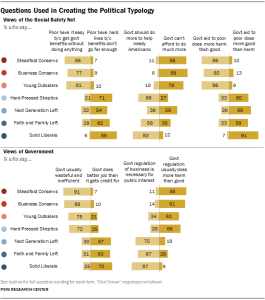
    Below is a sample of the questions Pew Research used in surveys to create its 2014 Political Typology or classification of American political viewpoint identities by which it and its clients may “know self.”


    The graphic shows a sample of 5 of many questions asked of randomly selected respondents. Much power over results is inherent in the framing, premises, and sequences of questions used.

    While the designed series of 2-choice questions may provide a more nuanced typology or classification of American viewpoint identity, the questions offer dichotomous choices that do not ask people to think beyond them. This forces selection of one of two predetermined responses.

    The real world of human beings isn’t dichotomous or constrained to seven types, but it is diverse, many-hued, multi factored, and changing. Still, Pew’s 2014 typology sought a more nuanced representation of political types using series of dichotomous questions.

    Yet what people really think and feel about the polity and life lived in it would be a much deeper discussion with each respondent probing their personal memories, history, relationships, actions, and formative experiences. It is hard to crunch all of that into two choices, much less a data set, and it suggests that we skew reality with the results we order by our question premises.

    It also works with what parties and their influencers create as limited choices. Such is a reversal of democratic input and of economic principles of supply meeting demand versus anti-competitive supply directing demand.

    Regarding the survey, the dichotomies ask for so little thought that responses cannot reflect full lives lived in the answer-views selected. Put another way, people reform their views to the answer selections. In such situations it is hard to know what they mean.

    In the graphic, notice the small grayscale line at the bottom that says: [“Don’t Know” responses not shown.] “Don’t know” responses could mean a lot of things, but they suggest that these respondents weren’t comfortable with either of the two given selections as true. If they cared enough to consider the question, they did not care for the answer choices.

    For those who checked-off one of the two choices offered, they might ask how those offered choices got there. If it was from past surveys, is it possible that answers from past surveys biased choices presented to new respondents? Could this lead today’s respondents checking viewpoint responses that sound familiar to them and not because they actually hold them?

    How good is policymaker comprehension of “self,” that is, the constituencies they are supposed to represent in office as if they were the constituency imbued in the representative person?

    If there is poor understanding of constituencies on matters of freedom, security, and defense, one begins to see the vulnerability of ignorance demonstrated by President Vladimir Putin the dictator of Russia whose autocratic personality and example (recently admired by Xi Jinping as similar to his own) deterred his own people from passing the truth up the line.

    No matter, right? The autocratic leadership model will make it up as it goes along, forcing the answers and ignoring reality until the reality they don’t know about themselves digs a sinkhole under the narrowly shared throne as did the second economy beneath the Soviet Union, and Vladimir Putin’s security state has done leading up to the Ukraine invasion.


  • If Russia Cannot Hold Ukraine What Does Victory Mean?

    If Russia Cannot Hold Ukraine What Does Victory Mean?

    Nine months ago, CSIS’s Seth Jones wrote at WaPo that Russia could defeat Ukraine but could not hold the territory. Today it is not even certain that Russia can “defeat Ukraine” much less hold it.

    To give it a serious try, Moscow would need to dilute its defenses along borders on its vast frontier. Moscow would have to trust its own frozen insurgencies not to rise up, especially while Ramzan Kadyrov sends forces into the high-attrition Ukrainian front.

    What will Moscow do if its insurgencies flare up across Russia to fill the security vacuum created by Putin’s Ukraine obsession? Nuke insurgents on Russian territory? Invite China’s PLA into Russia to stabilize it? Mortgage Russians’ future by either course of action?

    What does victory mean for Russia in Ukraine? Increasingly it looks like a genocide plan to physically erase sovereign Ukrainian civilization from the earth with bombardments. To sustain this, Moscow counts on illicit or inexcusable business partnerships with facile powers indirectly inviting Moscow’s parasitic inroads to their respective future political economies.

    If Russia succeeds in its genocide plan for claiming victory in Ukraine, what will that tell China it may do to push through its Belt and Road strategy? How many Eurasian and Far Eastern nations are in the path of the precedent Moscow under Putin would set by destroying Ukraine?

    Only Moscow and Beijing will benefit with increased leverage and influence inside countries making excuses for supplying Russia with means for fueling wars of genocidal aggression.

    Emerging nations would do well to hear from the West that Russia is trying to colonize or destroy Ukraine, and after doing so would likely escalate colonial leverage over emerging nations with its partner China.

    Of premium international value would be if emerging nations deny their supply chain resources to Russia, Iran, North Korea, and to the extent China supplies Russia-Iran, China, until Putin ends his war of aggression and exits Ukraine.

  • Governing Incompetence of the Siloviki

    Governing Incompetence of the Siloviki

    The Russian intelligence service veterans termed “Siloviki” who became self-dealing oligarchs, or “Silovarchs,”1 have all but destroyed the KGB-FSB-SVR-GRU brands with their incompetence.

    A metaphorical meme for Putin’s war on Ukraine could be Tom Clancy’s “Hunt for the Red October” scene in which the Lithuanian-born (today he could be Ukrainian) Captain Marko Ramius of the Red October head slams the smug, militarily unnecessary, and parasitic political officer (interestingly scripted with the name Putin) who had been spying on the Red October for the KGB.


    Today, a former comedian leads Ukraine on a hard road to freedom, a leader in his own right reminiscent of a combination of the surveyor who led the Americans, and a poet who led the Czechs, to freedom. This while out-leading a former KGB major whose every photo-shoot in macho situations to burnish his image as a “great man” should be causing him great social discomfort by now.

    Incompetence here means that the ill-trained, ill-prepared, and unconscionably deceived Russian military forces staged in telegraphed folly all about Ukraine for months are falling like flies in a hard freeze while the Russians’ non-suicidal military deterrent crumbles having been puffed but not prepared.

    The entire national security state of leadership elites including Putin failed utterly to plan and prepare for what they ordered done. How could that be? Because they were thoroughly corrupt as in Soviet times wishing to lavish the fruits of capitalism on themselves while subjecting the majority of Russians to regimens of servitude and poverty of which Putin is in part a product who forgot where he came from.


    In Stalin’s time, despite seeing their experienced officers murdered by their dear leader, ill-equipping, ill-supply, and deep losses due to same affecting Russian demography even today, the Red Army plugged along until Western Lend Lease gave them critical supplies on which to survive while God gave the Nazis a brutal winter likely to save the good children of Russia, not Stalin.


    Today, Russians must be better informed that they need not coddle parasitic rulers (whether extreme nationalists or cynical, corrupt spies) preying on their families and future to remain palace-dwelling legends in their own minds while others watch the loves of their lives march off to unnecessary war against those in a land they used to visit freely.


    1 Daniel Treisman, Putin’s Silovarchs, Orbis, Volume 51, Issue 1, 2007, Pages 141-153,
    https://doi.org/10.1016/j.orbis.2006.10.013. (https://www.sciencedirect.com/science/article/pii/S0030438706001141)


  • Might Russia have Hacked, Hijacked, and or Spoofed Ukraine’s S-300 Air Defense?

    Might Russia have Hacked, Hijacked, and or Spoofed Ukraine’s S-300 Air Defense?

    Purpose:

    This brief dispatch is to point out a possible, not certain, past reference raising the issue of whether (1) Russian network attack capability and/or (2) cyberattack using backdoors could have had a hand in the errant flight this past week of what evidence so far suggests are two Ukrainian (yet Russian designed and made) S-300 anti-air missiles flying into Poland and hitting a farm, killing two people. This in light of the strong denial from the Ukrainian chain of command.

    In 2007, Wired reported that Israel may have used its own tech analogous to U.S. tech developed by BAE Systems and L3 Communications to suppress air defense radar networks in Syria during Operation Orchard, which destroyed a Syrian nuclear weapons development project aided by North Korea. Wired paraphrased Aviation Week’s Radar expert Dave Fulghum to say that ‘there’s a bunch of Russian radar engineers studying the strike right now.’

    Citing U.S. aerospace industry and retired military officials, Wired reported this about such technologies:

    The technology allows users to invade communications networks, see what enemy sensors see and even take over as systems administrator so sensors can be manipulated into positions so that approaching aircraft can’t be seen, they say. The process involves locating enemy emitters with great precision and then directing data streams into them that can include false targets and misleading messages algorithms that allow a number of activities including control.

    What makes the above troubling is as London Times reported, that President Zelensky said his country was ready to apologise if the missile turned out to be one of theirs, although he added that he had been assured by Ukraine’s military General Valerii Zaluzhny that “it was not our missile or our missile strike”.  Yet NATO cited its preliminary missile tracking evidence showing that the missiles were indeed fired by Ukraine in defense against a Russian missile barrage which defensive launches ultimately hit the Polish farm. Ukraine insisted on joining the Poles and other NATO member specialists investigating what happened. All this, made the Fulghum paraphrase in the Wired piece stand out that after Operation Orchard, ‘there’s a bunch of Russian radar engineers studying the strike right now.’ 

    Fulghum followed-up with an Aviation Week piece indicating that Israel had consulted with U.S. experts before the strike and showed electronic prowess during Operation Orchard.

    More information is needed to determine whether the Russians since 2007 managed to get or develop their own communication network attack capability as described above, or whether Russia may have infiltrated the S-300 supply chain to Ukraine from former Soviet states and / or advantaged backdoors placed within the S-300’s by which it might take control of them.

    In March 2022, Russia threatened to attack Slovakia’s supply chain of S-300s to Ukraine, suggesting Moscow’s intense focus on former Soviet or more recently sold S-300 systems. Russia claimed it later hit said S-300s with cruise missiles which Slovakia denied happened. However, a cyber and EW attack might have been a less expensive approach to attacking the S-300 supply chain. Russia had also threatened another former Soviet satellite, Poland, if it dared supply warplanes to Ukraine.

    During the ongoing investigation, data recovery from digital avionics components surviving the missile strike will become important. There are firms such as VTO Labs, that can harvest data from damaged computerized assets that may help resolve some of these questions.

  • Deterring Supply Chain Aggression by China

    Deterring Supply Chain Aggression by China

    Set-Up: President Biden meets with President Xi Jinping before the G20 Summit on November 14th. Chinese leadership knows Taiwan is a vital manufacturing, trading, and freedom partner for the United States in the Far East. Hence, if China assaults Taiwan it knowingly attacks a U.S. vital economic national interest in its supply chain. Recent saber rattling from Xi Jinping puts the issue out front.

    In the context of such threats, Admiral Charles Richard, head of the U.S. Strategic Command warned last week that the state of U.S. nuclear and conventional deterrence is eroding while China rapidly acquires, steals, undermines, and supplants the United States’ capabilities, alliances, partnerships, and vital national interests. Admiral Richard predicted China could trigger a long war if it attacked Taiwan.

    Argument: If Beijing knew that a takeover of Taiwan would trigger a proportionate, measured U.S. takedown of similarly scaled and valued vital Chinese national economic and supply chain assets abroad (“Asset Retirement Countermeasures” or ARC), it could be a distinct deterrence buffer against open war over real estate. By communicating assured lost asset value for Beijing in mirrored increments to Beijing’s destruction of U.S. economic and supply chain assets, a predictable cost calculus abroad will be added to the direct risks of loss inherent to a Chinese military campaign against Taiwan.

    Inherent Costs Discussion: Inherent direct costs of invading Taiwan would include but not be limited to: direct military losses; financial costs; damaged trust with Asian and Pacific states or island possessions unsure whether Beijing will eventually do the same to them; newly galvanized trade and security relations between the West and such nations; damage to or loss of militarized assets in the South China Sea; the prospect of destroyed and sabotaged Taiwanese infrastructure, industrial machinery, goods, processes, and properties sought by invasion; internationally-imposed sanctions from friends and trade partners of Taiwan; risk of escalation to wider war regionally; opportunity costs in all lost assets including time, labor, and military force; lost current and future human capital value; health care to support disabled veterans and others; lost future investment; potential explosion of regional insurgencies; instability at home; and unintended consequences and costs of possible escalatory or backfiring behaviors by proxies such as North Korea. There is a stalking risk of escalation to exponentially wider warfare including the nonsensical strategic contradiction of mutually assured destruction.

    An implied strategic diplomatic and commercial cost of conquest: Beijing would lose Taiwan as a peaceful, valuable bargaining chip with the West it has possessed for decades for the pride of the island’s possession. If lost, it would leave China with the erratic Kim Jong Un regime of North Korea as its toxic, expensive, and limited bargaining chip at risk of blowback at its border, even as opportunistic, restive Eurasian nations and stateless ethnicities jockey for advantage as Russia weakens. These changes put the Belt and Road Initiative at risk.

    Working and playing by fair rules with free nations can retire these cascading risks.

    Internal Pressures on Xi Jinping: Countering today’s imperial-expansionist influence over Beijing are historic Chinese leadership traditions that value head-down, industrious behaviors supporting trade strategies sustaining prosperity for the people of China and their ruling imperial party castes and cadres. The pacification, unification, and funding from such is key to the unity needed for bona fide national defense and governing stability versus uncharacteristic global imperialism, a different animal.

    The intense, nationalistic animus punishing fellow Chinese such as that during Mao’s decade of Cultural Revolution last century, at Tiananmen Square, and in today’s high-tech totalitarian, authoritarian, and adventurist era of Xi Jinping have proven most successful in coercing Chinese at home and abroad to comply with Beijing’s imperial will and vision but not other cultures and countries with established national, cultural, or religious identities.

    Given intense imperial nationalism in Xi Jinping’s vision and rule more than internal pressures and external sanctions will be necessary to establish a layer of incremental deterrent balance between China and the U.S. to obsolesce Beijing’s Taiwan invasion calculus. This requires clear messages to Beijing that economic assets equivalent in value to a lost, vital Taiwanese trade and manufacturing partner for the U.S. will be removed from China’s balance sheets if China invades or dominates Taiwan.

    Politicized Overestimations of Economic Necessity

    China threatens Taiwan in part for fear that Taiwan can do a better job than mainland China in meeting U.S. and other free nation manufacturing and trade needs yet not only that, enable the U.S. to better compete with China for global markets, including emerging nations’. Forcing Taiwan to serve Beijing’s imperial will would be a self-guarding, anti-competitive, monopolizing move opposite of China’s liberalization under Deng Xiao Peng that provided foundations for Xi’s later distribution of prosperity. Yet without the liberalization that led to it, the continuing prosperity is less sure absent military mercantilism that is not realistic in today’s technological environment.

    Discussion of Asset Retirement Countermeasures

    Economic and supply chain assets and their values are features in the power scape between Washington D.C. and Beijing amenable to incremental rational deterrence as targets by degrees and means, from non-kinetic to kinetic.

    Touching on a deep channel in China’s historic leadership values sustaining prosperity over expansionist gambling and excessive tension-ratcheting controls at home,1 the U.S. and its allies could design a measured, quantifiable asset retirement approach as a deterrent buffer layer against the riskiest proposition for Beijing and Washington: open war with all of its costs, waste, and unintended consequences. Beijing appears to be betting that the U.S. fears open war far from home after Afghanistan and will only sanction China but not enter into all-out war and risk its naval assets. Yet maybe the U.S. does not need to worry about that if using other measures. 

    Without discussing specific Chinese assets around the world, suffice it to say that China’s global supply chains are also vulnerable to U.S. capabilities. That fact, properly understood as connected to the treatment of Taiwan, can help cooler heads prevail with greater reason to establish and follow fair mutual rules for peaceful trade and competition. 

    The Future Look

    By decoupling in national security business segments and resuming trade supportive of civilian needs and civilization, the U.S. and China could avert immense waste of assets in favor of each confronting the larger pacing, existential threats of planetary decline and resource renewal, plus the urgent need for poly-mutual, responsible space travel, orbital hygiene, exploration, and development. This approach could also set the stage to end wasteful tariffs.

    Perhaps a vignette illustrates the principle of prevention that Xi Jinping has the power to implement as a greater guarantor of his power than any course he now pursues. In 2020, U.S. and Chinese military firefighters found themselves helping Djiboutis extinguish a proverbial dumpster fire in Djibouti’s city dump. The event could symbolize what the world risks becoming if the two powers do not cooperate and cease undermining their respective qualities (not demerits) each contribute to the well being of the world and its peoples.


    Endnotes:

    1 Willy Wo-Lap Lam. “Is Hu Jintao a Reformer? Prospects for Liberalization in China,” Wilson Center. Apr. 27, 2006 (“Hu, along with his premier, Wen Jiabao, have been able to keep most Chinese happy, despite functioning within a Leninist party structure. They have co-opted the “red entrepreneurs” and the returned students from abroad, who number over 200,000.”).

  • Partisan Views on U.S. Military Readiness

    Partisan Views on U.S. Military Readiness

    The Big One is coming and the “U.S. military is not ready” says a story and narrative distributed with verbatim titling among many above-pictured, commonly aligned partisan news outlets. These sources morphed warnings from STRATCOM’s Navy Admiral Charles A. Richard’s deadly serious warnings that the U.S. ability to deter China is slowly eroding into the message that the U.S. military is not ready for a war if China attacks Taiwan. The latter non-readiness message could encourage China to attack sooner, whereas Admiral Richard’s real message would shore up that deterrence.

    It seems that few, and none better than Tyler Rogoway’s and Oliver Parken’s work at The Drive reported professionally on this timely, essential message from Admiral Richard.

    Admiral Richard did not say the U.S. military was not ready, but that it was losing ground in deterring war that would likely be protracted and would test the U.S. as it has not been in a long time. Admiral Richard’s actual comments assumed the U.S. could, with rapid action that cuts through the bureaucracy, reverse the erosion of deterrence and shore-up that metaphorically ‘slowly sinking ship’ of military deterrence.

    The partisan outlets share some ill-political motivation implied in their midterm election timing by misrepresenting Admiral Richard’s remarks in their headlines and leads, and some in the body of their opinions to pave the way for a Trump candidacy in 2024.

    Except that the U.S. Military was subject to 4 years of Trump from 2016-2021. It is now 2022: do we expect the impact of those 4 years has not influenced the current state of deterrence and readiness? If the military wasn’t readier after 4 years of Trump before whom there was bipartisan recognition of China’s military buildup, why not? One reason could be that Trump got rid of an effective Secretary of Defense, James Mattis, who was already  moving briskly on boosting military readiness, adapting to China’s rise, and proved he was realistic about Russia.

    In fact, SecDef Mattis, in his National Defense Strategy preamble directly forecast what Admiral Richard now warns us of:

    “Some competitors and adversaries look to optimize their targeting of our battle networks and operational concepts, while also using other areas of competition short of open warfare to achieve their ends…These trends if unaddressed, will challenge our ability to deter aggression.” (cited by Benjamin Nguyen, p. 17, at the link).

    Despite SecDef Mattis’ priorities and non-stop energy and work ethic, he was constructively fired by passive-aggressive, undermining tweets from Trump in 2018 just weeks after SecDef Mattis approved a crippling defensive strike on Yevgeny Prigozhin’s Wagner Group unit leading Syrian regime-proxies into battle against Kurdish positions in Syria containing allied U.S. troops.

    So more Trump leadership will make the U.S. military more ready? Where is Trump’s impetus to do so? He clearly claimed NATO was obsolete, America was what Putin serially accused it of being in the world, and should isolate itself at home letting the world and its many resources fall under Eastern dictators’ influence while confirming their influence narratives with policies that reinforce them in the minds of emerging nation leaders. Lockstep in speaking angry narratives about the United States as shared with Putin do not convince me that Trump was in good faith with his big talk about being pro-military.

    When you see headlines and partisan studies such as that put out by the Heritage Foundation about the military being unready, can we ask why the Heritage Foundation did not come out during Trump’s 4 years in office and declare the U.S. military unready for China after years of predictions that rivalry with China and China’s military buildup required it. What was Trump doing if not tweeting the United States into deeper division?

    An added negative effect of this attempt to obtain one’s preferred party in the White House despite poor results getting the military ready? It enables Trump loyalists who threaten betrayal of a third key ally, Ukraine, to drive a repeat of the humiliating, agitating withdrawal from Afghanistan with a low quality plan, low quality exit strategy, and low quality result.

    Shall we tolerate a partisan set of agitators in Congress and the fearful, hand-wringing media abusing the First Amendment freedom of the press to throw itself into unprofessional partisan political servitude that helps autocratic rivals?

    We need a free press corps that adopts the Dragnet approach and reports “just the facts Ma’am,” and those, in greater factual context.

    SecDef Mattis saw the very real need for rebuilding U.S. alliances. President Joe Biden’s team, post-Afghanistan, has built and supported U.S. alliances while forming AUKUS, a new one, which in time should add Japan and South Korea. And President Biden’s team has overseen the inclusion of strong future members in NATO, Finland and Sweden.

    While the Biden Administration has suffered much bad P.R. and no small amount of agitation propaganda and disinformation attacks on it, it has actually been doing a fairly good job on Ukraine and in rebuilding U.S. alliances that will be much needed as the autocratic chieftains rise on the flanks of the free world, aiming to snuff it out.

    The one thing the Biden Administration must immediately achieve diplomatically at home is to win over the U.S. oil patch to curb inflation and reduce dependence on Saudi Arabia and OPEC Plus: cut a deal with Big Oil on the coming energy transition, giving them a bigger role in that transition, and hammer out the details.


  • Putin Like Hitler Invokes Christ for War of Aggression

    Putin Like Hitler Invokes Christ for War of Aggression

    A Russian military officer, trying to religiously motivate his troops to join the war of aggression against neighboring Ukraine, many in Ukraine also being slavs and Orthodox Christians, had this to say according to a source cited by Yahoo News: “I promise that we will win this holy war…Who is fighting against us? People who say that their God is Satan. Satanists are at war with us. People who insist we attend LGBT parades.”

    Where did he get that from? From the anonymous internet propagandist “Q”? More likely, “Q” got it from Vladimir Putin who reportedly has said in his desperation to justify his war of aggression against Ukraine:

    “The dictatorship of the Western elites is directed against all societies, including the peoples of the Western countries themselves. This is a challenge to all,” Putin said.

    “This is a complete denial of humanity, the overthrow of faith and traditional values. Indeed, the suppression of freedom itself has taken on the features of a religion: outright Satanism.”

    Never mind that the initial justification for invading Ukraine with a massive force of over 100,000 Russian troops was to de-nazify Ukraine. And yet there is irony there considering how similarly Putin’s appeal to the Christian faith as justification for a war of aggression sounded like Hitler’s:

    Wir sind verschieden gläubig in Deutschland, sind aber eins: Welcher Glaube den anderen besiegt, das ist nicht die Frage, vielmehr, ob das Christentum steht oder fällt das ist die Frage!

    Translated via Google Translate: “We have different faiths in Germany, but we are one: which faith conquers the other, that is not the question, but whether Christianity stands or falls, that is the question!”

    Putin’s rhetoric sounds even more apocalyptic than Hitler’s attempted Christianization of his genocidal plan for the Jewish people, in that Putin lumps Western civilization into the Satanist camp as some of his military officers are apparently doing.

    Now have a look at a supposed “Russian Orthodox Christian” Cathedral Putin commissioned as covered in this Guardian piece, entitled, Angels and artillery: a cathedral to Russia’s new national identity Cathedral of the Armed Forces blends militarism, patriotism and Orthodox Christianity to controversial effect.” 

    Below, see militarized themes in and surrounding the Cathedral with some points of interest.


    Sources: https://www.rferl.org/a/consecration-of-the-main-cathedral-of-russian-armed-forces/30671707.html

    https://theconversation.com/what-a-cathedral-and-a-massive-military-parade-show-about-putins-russia-182485

    https://www.theguardian.com/world/2020/oct/20/orthodox-cathedral-of-the-armed-force-russian-national-identity-military-disneyland

    https://theconversation.com/holy-wars-how-a-cathedral-of-guns-and-glory-symbolizes-putins-russia-176786

    https://www.asianews.it/news-en/Stalin-and-Putin-disappear-from-Moscow%E2%80%99s-Victory-Church,-but-more-can-be-seen-(Gallery)-50096.html


    To compare the militarization and state-servitude of the Russian Orthodox with an historical church in Germany, see the following images from inside a Nazi era church with the swastikas removed per German law:


    The militarization of the Christian faith contributed to the war that victimized Russia when it was under Stalin’s Soviet leadership, and which Putin uses to justify his war against Ukraine today. By self-serving association, Putin puts the entire West with all of its diverse peoples, faiths, faith traditions, freedom of worship, and freedom of speech including religious speech, in the satanism category. It is a conspiracy theory of victimhood that is very much like that which Hitler aimed at the Jews.

    Yet this is not just an irony pointed out in a post trying to be interesting. This is a reality developing in the sick Russian state and its influence over the Russian people that currently endangers Europe and the World with nuclear threats.

  • Utilize Russians Fleeing Draft to Write Russians at Home

    Utilize Russians Fleeing Draft to Write Russians at Home

    There is a mass exodus of Russians avoiding Putin’s war observed by media in and outside of Russia, with up to 700,000 Russian men according to unnamed Russian official sources cited by Forbes, Russia. Reuters has been using the words “tens of thousands.” 

    Russian exiles have native literacy, fluency, and knowledge to write colloquially and credibly to fellow Russians using email, messaging, and VPN services reaching into the Russian internet as suggested by the U.S. State Department in its chronicle of Putin’s military aggressions against Ukraine, its cities, and civilians.

    Apps and services that brave Russian exiles can use to share images, video, facts, observations, and stories with fellow Russians at home are listed below. They should show the damage done to Ukrainian civilians, domestic Ukrainian life, and to Russian draftees and society courtesy of Kremlin deception about the so-called “special military operation.” How the Russians against the war can use their linguistic power to end the war:

    Outline allows you to set up your own VPN server and then give Russians free and safe access to the global internet.

    1920.in lets you send texts, WhatsApp messages, and emailsdirectly to random Russians with the truth about the war.

    At mail2ru.org, you can email up to 150 Russians at a time, drawn from a list of more than 90 million email addresses, including members of the Russian parliament.

    With the war of aggression backfiring on Putin on the ground, only overwhelming messaging and news from their fellow Russians written so that it is clear that Russians with recent local knowledge are writing to them, can sway the Russian people to rise up and stop Putin and his KGB-bureaucrats, none of whom have people in harm’s way at the front.

  • Target Logic: Shahed-136 Drones

    Target Logic: Shahed-136 Drones

    The Russians are aiming Shahed-136 drones at Ukrainian energy nodes, buildings, and other infrastructure items, such as communications. The Shahed-136 suicide drone uses commercially available GPS as a guidance system, making it susceptible to jamming devices. 

    In December 2021, Israel’s Jerusalem Post published a well-informed advance warning of the capabilities of Iran’s Shahed-136 including longer range, missile use, and concealed, mobile truck-based, multiple launch systems. Today, the same source offered air defense recommendations to Ukraine for the “multi-layered integrated air defenses it needs.” Many of the means mentioned, compared to the relatively inexpensive Shahed-136 create an imbalanced tax on Ukraine’s air defense resources.

    And in June 2022, authors John Hardie, Ryan Brobst and Behnam Ben Taleblu at Breaking Defense warned in some great detail that Ukraine’s supporters should help Ukraine prepare for the use of Iranian suicide drones, loitering munitions, and possible radar-targeting munitions. They also recommended re-establishing the U.N. arms embargo on Iran.

    Earlier than all of the above sources, on January 25, 2022, the Strategy Shelf advocated for early-implementation of air defense systems on behalf of Ukraine as a means of humanitarian aid to protect civilian life and infrastructure.

    Stopgap, it is our assessment that a high-value target-centric defense and layered approach will help balance the resource equation in Ukrainian air and object defense against Iran’s low cost drones. Ukrainian forces no doubt need more electronic warfare and drone jamming tech with controllers communicating with early warning observation and radar sites radiating out from high value target areas. These should be deployed to encircle energy, defense, communication, health care, transport, supply, and other infrastructure targets.

    Building rooftops and nearby high points could also use drone jamming and EW tech in addition to sharpshooters strategically placed for coverage of civilian areas. Tracers and possibly infrared will help sharpshooters and jammers (respectively) to see and kill drones at night. Offering incentives and rewards to all who support Ukraine to introduce low tech methods of killing Russia’s drones, conditioned on training on how to identify the drones used by Russia, could be of value. The more threats to the drones, the greater the cost of deploying and employing them.

    The issue of truck concealment brings to light the need to identify drone-servicing truck trailers by contrasting their presence and profile against past trucking routes or routines, then finding ways to further identify a truck’s behavior, purpose, location, and features contrasted with other trucks used in the areas of likely launch. This may aid in predictive surveillance priorities supporting air defense and could even be a private sector OSINT task.

    Iran’s supply of Shahed-136 drones targeting Ukrainian civilian targets that are financed by the U.S. and international community as U.N. recognized humanitarian and self-defense aid to Ukraine arguably tread on a vital U.S. national interest justifying U.S. interdiction operations against Iranian drone shipments, manufacturing, and supply chains.

    Separately, Iran should be identified as a sponsor of terror against Ukraine for supplying Russia with drones Russia is using to attack Ukrainian civilian lives, infrastructure, supplies, self-defense items, and other sovereign Ukrainian rights. Here, Iran becomes the terror sponsor and Russia their proxy. Such lawless terrorism under past circumstances justified military retaliation for terror sponsorship. Israel, for example, has in the past preemptively struck Syrian missile supplies capable of carrying chemical weapons, and sites supporting Iranian sponsored Hezbollah inside Syria.

    In March 2022, Ynet News reported a strike on an Iranian drone facility, possibly by Israel, to preempt Iran’s use of drones in an ongoing campaign of Iranian proxy attacks on Israel. In August, the Iranian Army boasted of an underground drone base at an ‘undisclosed” location, touting its growing drone arsenal. A video purports to show it here:


    With U.S. lend lease aircraft or a “loan a drone” program, perhaps Ukraine could do the same if the U.S. prefers not to do it itself, however justified that would be.

    It is our assessment that the U.S. has the right to interdict the integrated supply chain of Iranian drones, munitions, and war tech used to terrorize civilians in Ukraine and take down their vital infrastructures. The U.S. is financing the Ukrainian people with multipurpose aid to help them remain alive and free, the investment in which is a vital national interest. The U.S. need not sit by and see its vital national interest wasted by terrorist vandalism, sabotage, and killing sponsored by Iran against the Ukrainian people and their sovereign state.

    Such U.S vital national interests include the goodwill and solid alliance with Ukraine as a fellow free nation in the world as a matter of international freedom to form international alliances. Likewise, it must be remembered that there was evidence “that the Iranian Revolutionary Guard Corps (IRGC), through its special Quds Force, has provided weapons, explosives, roadside bombs, and other forms of support to elements of the Afghan Taliban,” as early as 2010, and that Iran likely provided terrorist supplies for sticky bombs that destabilized Afghanistan’s political structure at great loss to the investments of the United States and NATO allies in Afghanistan.

    Shall we allow them to do it again in Ukraine and do nothing? That would not be a good strategy for protecting U.S. interests going forward.

    Finally, the Iranians have opened a drone factory in Tajikistan for surveillance drones, however, it must be determined if the same factories are being used to produce the Shahed-136 and like drones and munitions for Russian use against Ukraine, then the right actions taken to stop such production.