Corporate leaders do not fulfill fiduciary duty to shareholders in the spirit of the laws by allowing company property, some of which enables strategic advantage over free nations, to slide into the maw of autocracy. The Congress and legislatures of the United States, the 50 states, and U.S.-based business lobbies have embraced a zombified version of fiduciary duty to deliver short range profits while handing corporate property rights to autocrats for market access.
The foundation of free business is constitutional republican democracy (CRD) without which no private business would be free to innovate, own, hold and use private property according to the will of its ownership. Nor would business leaders be free to manage supply and demand to serve the best interests of shareholders, customers, suppliers, creditors, and vendors.
IP-rights-for-market-access and other autocrat-leveraged arrangements divert taxable royalty revenues away from U.S., state, and local tax bases to authoritarian regime accounts.
The spirit, rule of law, and policy question for CRD-based businesses is this:
Should Congress legislate that business decision makers’ fiduciary duty to shareholders includes the duty to uphold the sovereignty of their CRD that in return provide for the security and rights of lawful U.S. businesses and workforces? The answer is an overdue yes.
If fiduciary duty law does not expand to embolden corporate leaders to uphold CRD in international business relations, China and Russia will continue to manipulate free nations’ shallow fiduciary duty law to serve relatively short term shareholder profits over the perpetuity of private property and free business rights themselves.
Corporate decision makers will continue to fear shareholder liability under current profit-centered fiduciary duty law should they reject autocratic offers of market access.
Under the currently anemic fiduciary duty law scheme, U.S. and allied CRDs are on the ropes after immense strategic losses in intellectual property, trade secrets, energy market share, gray influence warfare, and competitive advantage to China and Russia.
Congress must act to legislate a constitutionally-expanded definition of officers’ and directors’ fiduciary duties to uphold CRD as the source, guarantor, and guardian of private-propertied, free business.
The Ohio Republicans’ treatment of Rep. Gonzalez reveals an autocratically re-aligned GOP entity in which a GOP member cannot exercise representative conscience under his oath to uphold the U.S. Constitution by voting to impeach the former head of the GOP for inciting an attack on the co-equality and independence of the U.S. Senate in its election certification role. And that, based on frivolous lawsuits and anemic evidence against which the traditional GOP advocated “tort reform.”
Retaliating for Rep. Gonzalez’s vote to impeach him, the ex-President called Rep. Gonzalez a “sell-out”in June 2021 as if constitutionally-framed political conscience was something for sale. The Ohio GOP censured Gonzalez, and indeed, one could say it censored him, too. The Ohio GOP in this case, behaved like the old Soviet communist party, banning conscience and intellectual dissent with regard to a personality cult leader of “The Party.”
Together with the Q-element infecting the GOP today, this personality-cult problem expresses more of a mass psychological operation of reflexive controlthan a domestic political shift anywhere in particular. Much of the GOP has aligned itself with a man who behaves as dictators do the world over, and gives comfort to dictators and autocrats who have realized more power and favor in the past 4 years than they had as satellites of Moscow and Beijing in the 20th Century.
As Rep. Gonzalez steps away to shelter his family from the scorched-earth politics mainstreamed in the GOP by Trump-pardoned felon and nihilist Roger Stone’s corrosive influence, fringe conspiracy-theorists falsely cloak themselves in the Republican Party brand and run for office so as to deepen the personality cult and fanaticism in the GOP.
How did it get this bad? The potential in the GOP to be leveraged by an adversarially-controlled demagogue hit an obvious tipping point in the litigated election of Bush v. Gore, 2000. In two years prior, Vladimir Putin had been given the time as head of the FSB in 1998 and as First Prime Minister in 1999 to forecast the nearness of such a tipping point from his ‘main enemy’s’ litigation of the Clinton impeachment as if the “gridlock” complaint memorably panned by Ross Perot in the 1992 Presidential election were prophecy coming true. Indeed, the partisan wars from Watergate to Monicagate did set the stage for anger over unresolved, gridlocked issues heating-up the nation’s politics such that a third party exploit might provide a tipping point for a foreign intelligence effort.
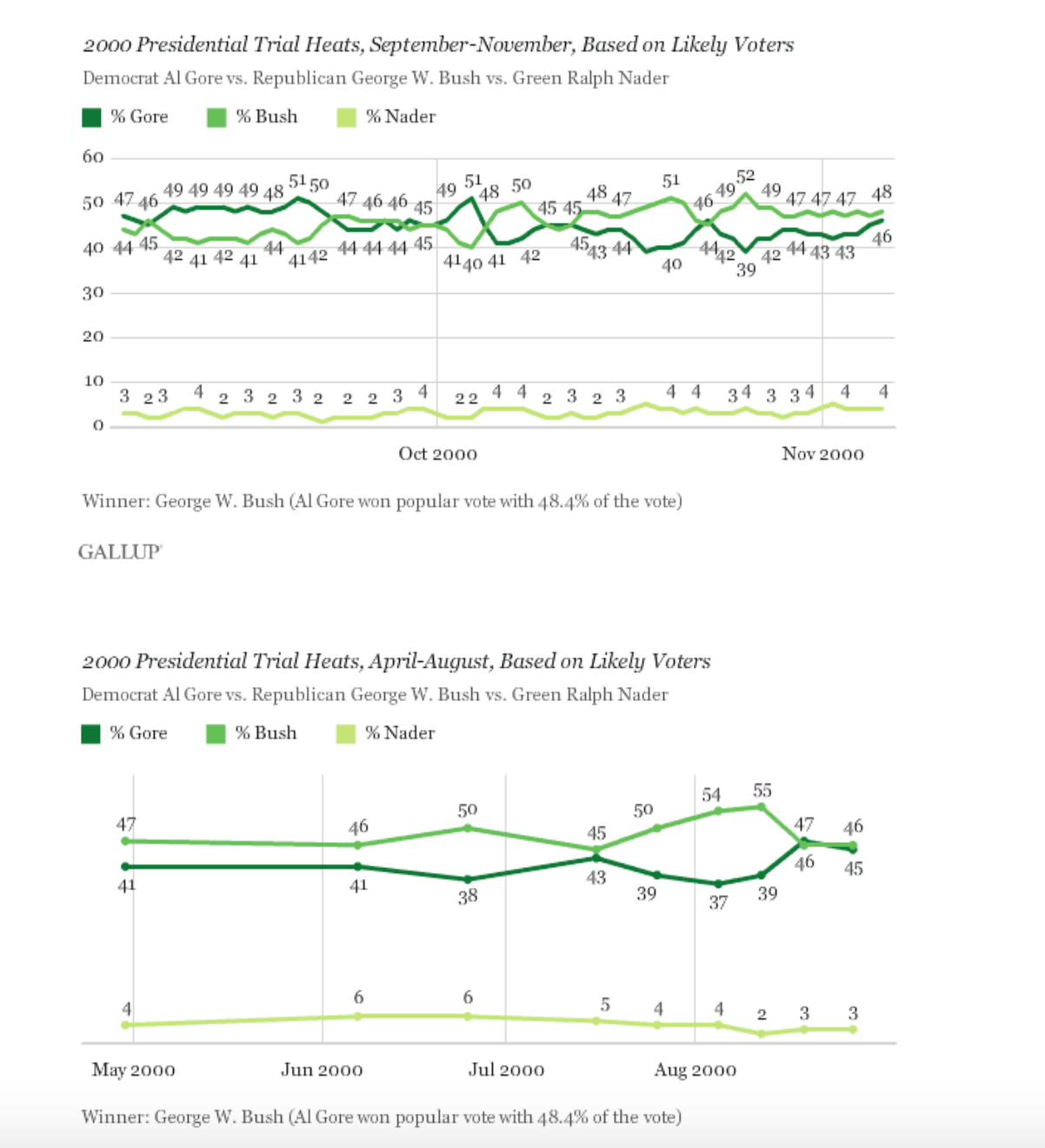
The Gallup polls during the 2000 presidential election season (seen below) would have provided Putin’s KGB-dominated Russian state with confirmation that political warfare operations against the United States could work, and would be the most cost-effective end-run around U.S. military superpower. Spoiled American civilian society and leadership would have to become the inroad to undermining U.S. military and economic advantage.
The Russians have centuries of experience with political intrigue, human manipulation, personality cultism, provocation, mental warfare, infiltration, and deception. With the internet, Putin and his KGB regime could leverage that experience into American homes and offices via desktops, laptops, and phones. That these highly-effective devices had brought Americans to a stage of psychological obsession, addiction, dependence, and short-attention span was all the better, for all Russian intelligence had to do was reach through those devices into American hearts, minds, and neurological responses to reach those with the most malleable anger, and even better, the guns.
Moscow’s window of opportunity to exploit the tipping points on display and vie for control over the United States Executive branch was concealed by what nearly a century of Soviet autocratic political, economic and military pride and competition could not achieve: the disarming of American vigilance through the appearance of Russian weakness in all of the traditional instruments of power, including HUMINT.
Americans in their hubris considered Russia’s HUMINT capabilities passé compared with U.S. technological intelligence acumen. The Russians understood this. Then, Russian HUMINT merged with CYBERINT and SOCMINT and rode trojan horses across the open internet cables to cast spells of technological and human psychological influence on Americans’ desktops and laptops, accessing the Facebook social lives of unwitting, unprepared, and unsuspecting Americans. Of U.S. war veterans. Of blue collar business owners and workers alienated by feeling obsolete as high tech replaced low tech.
It was online that the SVR, GRU, and FSB would pose as American patriots throughout the Obama years and contrast Barack Obama in memes with every white action hero, war veteran, and macho personality there ever was, including Putin, while aligning Obama with terrorists based on Birther- disinformation, Islamist innuendo, and hatred for Obama’s Ivy League erudition as if none of that had to do with resentful racism.
All of that chatter may well have made President Obama react to the provocations in ways that made him appear to fit the stereotypes, as the Obama Administration did not then have the intelligence about the extent of Russia’s weaponization of Facebook, Twitter, LinkedIn and other platforms. Such was provocation warfare permissively entering into the historic social scar-tissue of American demographics.
In the 1990s Putin’s cadres had tracked former Soviet communist party officials that went West and became clients of connected U.S. lobbyists. Those that would not follow Moscow’s dictates, Putin in the 2000s would eventually crush or cow. Those that helped Moscow achieve foreign intelligence objectives, not so much. Roger Stone and Paul Manafort had capitalized on representing former Soviet officials, oligarchs, and proxies, shopping for influence, business inroads, and luxury in the U.S. Putin’s FSB no doubt knew much about Roger Stone, Paul Manafort, and others through their former Soviet clients. Stone’s amoral and nihilistic history with Richard Nixon was so much dirty icing on the cake.
In considering the likelihood of a relationship between Moscow and Roger Stone, Stone’s claim to C-SPAN that he was a “volunteer” exploratory committee chair for Trump’s look at a 2000 presidential run raised a red flag, for as a lobbyist with a history of representing former Soviet foreign nationals, if he were working for same, could he not claim the volunteer exemption that a foreign national could claim from the Federal Election Campaign Act so long as he did not participate in campaign decisions or contribute money? And that, because lobbyists for foreign nationals don’t have to register under the Foreign Agent Registration Act so long as they satisfy the federal Lobbying Disclosure Act and the principal beneficiary of their activities is not a foreign government or political party? Given the history of Stone’s behavior, these are reasonable questions in hindsight.
A third party had never been able to win an election against a mainstream party for President in the U.S., but may have caused one or the other mainstream party to lose elections. From Putin’s perspective, if the most powerful elements of a third party with overlapping hot-button issues with one of the mainstream parties was to infiltrate one of them, which would make more sense? The GOP or the Democratic Party or both? Such a Trojan horse movement, properly organized and funded, could provide the people, energy, motives, and sentiments to challenge and pressure aging party leaders by attacking their roles in gridlock on one-issue controversies such as gun rights, abortion, race, and immigration. Indeed, the Soviet history of seeking out Left Wing movements in the U.S. lacked gunpowder. To infiltrate and influence a bloc of Americans with the guns would add new options that Russian intelligence could take much further.
In 1999, Stone and Trump learned a great deal in furtherance of such a stratagem when Stone chaired Trump’s exploratory committee for a Presidential run under the Reform Party, discovering wild and woolly fringe groups, an actor-macho veteran in Jesse Ventura, a former KKK Grand Dragon and anti-Israel firebrand David Duke; anti-government militia groups; and single-issue fanatics with overlapping counterparts in mainstream party blocs.
The Reform Party had become factional and had retreated from the United We Stand ethos under Ross Perot’s leadership in 1992. After sampling and inciting some of that factionalism to further divide the Reform Party internally, Stone and Trump announced their withdrawal from consideration under the Reform Party under the guise of finding it too bigoted and divided to patronize. In the process, Stone had discovered much about tipping points and how to recruit Reform Party spin-offs into something that came to be known as the “Tea Party.”
In a series of emails, one can see Roger Stone’s imprint and style shared also by Trump in his operative communications aimed at dividing, leveraging, and commandeering elements of the Reform Party to infiltrate the Tea Party movement and run it as a Trojan Horse inside the GOP to usurp, divide, and party and use it as a weapon to balkanize the United States.
It helps to update information defense nomenclature in ways that precisely target attack vectors aimed at our national security. Recently, attacks on U.S. and allied health security seek to tie-up U.S. resources and mental bandwidth on complex iterations of alternative health narratives that take on ‘Big Pharma,’ the “medical establishment,” and corporate health as dramatic camouflage for information warfare attacks on crucial U.S. and allied COVID-19 vaccination campaigns.
“Quackaganda” is a suitably irreverent term referring to faux-sophisticate disinformation and or misinformation degrading public health responses to infectious diseases, undermining clear and accurate health information, and damaging popular thinking about and trust in public health efforts and authorities.
Where disinformation and misinformation can lead to death or degraded health in mass populations of targeted societies, it could be “Black Quackaganda.” COVID-19 anti-vaccine disinformation is like that because it tends to slow and suppress vaccine compliance and effectiveness. This creates time windows mostly in unvaccinated populations for COVID-19 to mutate at risk of generating more lethal strains.
Samples of Quackaganda
Consider recent samples of Quackaganda making internet rounds like the plague-carrying horseman of the apocalypse, mixing falsehoods with truths to try to persuade people not to get vaccinated, or, to obstruct vaccination campaigns.
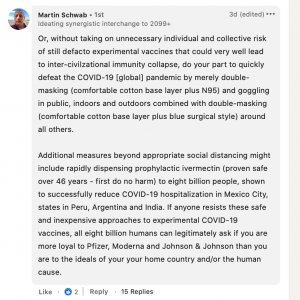
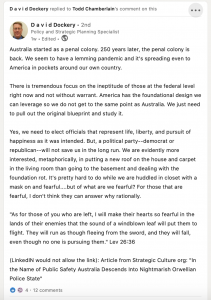
In one case of “Quackaganda” at LinkedIn, a commenter urged alternatives to COVID-19 vaccines, arguing that they “could very well lead to inter-civilizational immunity collapse.” He advocated double-masking, goggles in and outdoors, social distancing, and “rapidly dispensing prophylactic Ivermectin..to eight billion people, shown to successfully reduce COVID-19 hospitalization in Mexico City, states in Peru, Argentina, and India (Italics mine).” See below:
Ivermectin is a livestock de-wormer and anti-parasitic that some foreign case studies correlate with less severe outcomes from COVID-19, however, do not prove causal links between Ivermectin and reduced COVID-19 hospitalizations. For example, the killing of parasites in a cross-section of patients with COVID-19 may have enhanced the immune system response and potency of patients no longer battling the parasites. That would not necessarily recommend the drug for the non-parasitized, if true. It seems too early to tell, but the above commenter takes it a step further to suggest that Ivermectin treatment and containment behaviors should replace vaccination (the anti-vaxx underpinning to the Ivermectin pitch).
As a treatment for COVID-19, Ivermectin would itself be experimental and not proven across dosages, particularly if administered prophylactically to 8 billion people given the drug’s known side-effects, interactions, and unknown effects on human organs of the sort of dosages theorized to be needed to defeat COVID-19 hospitalization.
Note also the agitation propaganda narrative at the bottom of the comment above:
“If anyone resists these safe and inexpensive approaches to experimental COVID-19 vaccines, all eight billion humans can legitimately ask if you are more loyal to Pfizer, Moderna and Johnson & Johnson than you are to the ideals of your your (sic) home country and/or the human cause.”
Strategic Communications Profiles
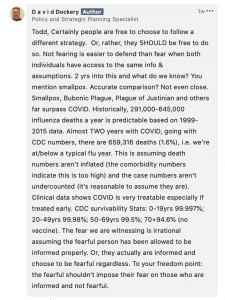
Then come the strategic communications types, sometimes hired to advocate for politically powerful interests on social media, mixing partly-accurate information, unsourced data, falsehood, excessive license with data, mis-stated definitions of medical terms, and more. Here is an example of that in which the commenter grossly inflates annual influenza deaths to make COVID-19 death statistics look more like a conspiracy of fear-mongering, capitalizing on distracted Americans’ lack of currency with the actual comparative numbers:
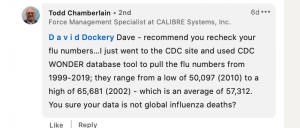
Below was a corrective response that exposes the inflated influenza death numbers cited by the above profile as blatant mis or disinformation:
The same profile posting false influenza death numbers for the U.S. had also spuriously claimed that myocarditis meant permanent heart damage after overstating incidences of myocarditis post-COVID-19 vaccination. Further review of the profile’s content revealed something else. Citation of a known Russian government agency website, “Strategic Culture Foundation,” in support of anti-vaccine efforts designed to make our ally Australia appear to be “Orwellian” (see last para in comment image below):
In late August, TIME magazine published investigative journalism that helped to illuminate a number of sources of Quackaganda. It is essential reading for those who wish to understand the kind and character of the people behind the recurring iterations of anti-vaccine ideology that evolves much like a virus.
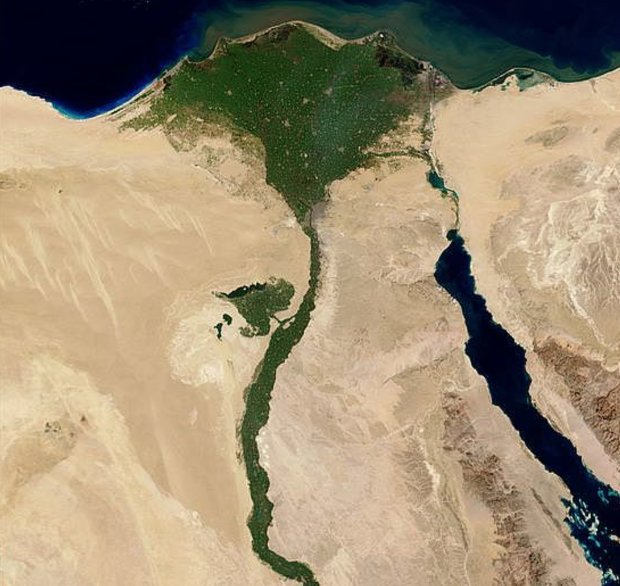
Fact: The Zambezi River Authority (ZRA) is a joint corporation formed by the governments of Zimbabwe and Zambia mostly to manage, operate, and maintain the Kariba Dam on the Zambezi River in service to the populations of both countries. The ZRA also focuses on riparian co-conservation and co-management. The two nations share costs of management, upgrades, and new construction with international and private funding sources.
Question: Does the Zambezi River Authority model and experience offer guidance for a poly-mutually, beneficial way forward for using and managing the GERD and related Nile River conservation projects between Ethiopia, Egypt, and Sudan?
Takeaway: Organized water-cycle management efforts insuring efficient, sufficient, healthy, and effective water supply and usage suggest that there is no rational necessity for imposing existential threats over water sources and cycles where international collaboration and investment can ultimately save more total resources than would be wasted on inefficient, unsustainable conflict. However, time is of the essence where advance planning has been neglected, and water supply, usage, technology, and re-collection solutions take time, expertise, and collaborative work ethic to realize.
Purpose: To analyze open source information about (1) the strategic context and (2) chain of events leading to the massive ammonium nitrate explosion in Beirut’s port on August 4th, 2020, killing some 200 people, injuring over 6,500, and displacing 250,000.¹
Pre-and-Post Explosion Context
Lebanon Generally: Modern Lebanon with its East Mediterranean ports2 has been a coveted game square for nations, multinationals, political religions,3 terrorist groups, sectarian militias, criminals, and refugees trying to survive.4 It is also a generational home to people with little or no collective control over these forces. In part, the political economy of sectarian corruption had degraded the foundations of Lebanon’s collective security to the point that its political, legal, and security elites knowingly, willfully allowed Beirut to blow-up.5
The corruption of Lebanon’s government is a truism by now, however, and this analysis looks into open sources to better understand how outside forces and influences formed up around the explosive event. Lebanon had been on the ropes before the port explosion, with blinkering utilities, inefficient services, massive debt, poverty, protests, calls for revolution, and COVID-19.
Seeing Russia as the best hope to quell the neighboring civil war before it spread to Lebanon, Lebanon sent then-Energy Minister Gebran Bassil to Moscow in 2013 to sign a Memorandum of Understanding on energy cooperation with the Russian Federation as a part-incentive for Russia’s decisive action to end the civil war. By doing so, Lebanon likely entangled its resources with Russia and Syrian post-war reconstruction.
The Syrian civil war worsened and Russia intervened in 2015. It took four more years for the Russian military and Assad’s forces to get the upper hand in Syria with help from Tehran. By 2019 Lebanon had licensed a non-operating Russian firm with French and Italian operators to exploit its offshore oil and gas. Per Al-Monitor:
Yet Lebanon’s offshore project also faced delays in suppressed oil prices caused by the Russo-Saudi oil price war in 2020, COVID-19 slowdown, and its dispute with Israel over their maritime border and Exclusive Economic Zones (EEZs), including rights to undersea oil and gas blocks that Russia’s Novatek and France’s Total were licensed to explore.
In 2019, Israel had called Lebanon’s licensure of block 9 provocative, and President Michel Aoun called Israel’s claim to block 9 “a threat to Lebanon.”
Less than four months later the Beirut port exploded.
Super and Great Power Competition: Russia and China have offered emerging nations autocratic alternatives6 to relationships with western democracies in finance,7 construction, arms,8 aid,9 energy, maritime commerce, and trade. Russia and China have not hidden ambitions in Lebanon or the Mediterranean,10 building diplomatic, security, and military influence on previous gains in Eurasia, the Middle East, Africa, cyberspace, space, and elsewhere.11 The competition is quickening.
Separately and together, China and Russia have pressed a global gray war to reverse and supplant western democracies’ public and private presence and influence abroad, including in Lebanon.12 For this report, ‘gray war’ means, at a minimum, sub-kinetic warfare through weaponized diplomacy, subterfuge, influence, information, sabotage, and hacked or stolen advantages that can turn kinetic through deniable agency or incitement.
In this geopolitical competition, seemingly legitimate business competition from China or Russia is tainted by their state-backed gray warfare from the perspective of free markets and private enterprise.
Recent Uptick in Russian Activity Courting Lebanon’s Ruling Elites: Tel Aviv University’s Institute for National Security Studies has noted intensified diplomatic activity between Moscow and Beirut in recent months. U.S.-based Armenian Weekly cited Lebanese government releases listing 14 meetings between Russian and Lebanese officials in the past three months reporting Russian efforts to broker a unity government in Lebanon even as it continues to seek more energy, reconstruction, and development contracts with Beirut. Most recently, Beirut tapped Russia for help in rebuilding grain silos destroyed in the Beirut blast and new grain silos at the Tripoli port.
The latest Russian efforts appear to be aimed at protecting and leveraging Lebanon’s corrupt, ruling elite at a time when the majority of Lebanon’s population wants them out.
Israel: As Russia and China rise in the region, Israel has been recalibrating its national security after the Trump Administration signaled a reduction in U.S. commitments in the Mideast and Africa. Israel expanded normalized relations with the U.A.E.,13 Bahrain, Sudan, and Morocco,14 while navigating its traditional Ethiopian relationship as a counterweight to autocratic and terrorist influences in Africa.15 Time will tell how reliable these new relationships are as China buys majority stakes in management of one key Mediterranean port after another, and Russia builds bases for military and private mercenary units in several African states.
In the above context of decreased U.S. roles in the Mideast, Israel’s offshore oil and gas is more critical than ever to Isreal’s future security. For Israel and Lebanon, a positive, sustainable maritime boundary resolution could open-up opportunities for future negotiations on Israeli-Lebanese border security cooperation if there was an end to the corrupt sectarian system running Lebanon.
Currently, however, Russia’s efforts appear aimed at unifying and bolstering Lebanon’s governing elite, not removing them.
Syria: A recurring regional weakness is the Assad dynasty in Syria, which has repeatedly undermined Lebanese, E.U., Mideast, Israeli, and NATO member security over the decades. In 2011, Syria cracked down on dissenters, put them in concentration camps, and inflamed a civil war that drove masses of refugees into other sovereign countries, spreading instability . Syria’s leadership has also hosted Iranian proxies that attack Israel. During the Cold War, Syria used nazi war criminal Alois Brunner and East German Stasi as advisors and trainers of Syrian security services, shaping the institution. This sad fact helps explains why today there is a Caesar Act and photographic exhibits of Syrian concentration camp victims under Bashar-al-Assad (see also HRW’s site).
By insisting on supporting regimes like the Assad and Kim dynasties, Russia and China keep them as strategic wildcards that cause international diversions, divisions, provoke free nation responses, and otherwise serve Moscow’s and Beijing’s strategic and tactical ends. When free nations respond with force, Russia or China excuse themselves from multilateral obligations on the false pretext that the world’s democracies do not respect national sovereignty of emerging nations. And yet it seems that WMD-proliferating, crime-state satellites such as Syria and North Korea never really seem to “emerge” as thriving or prosperous nations. They do, however, as zombie satellites, tend to help Russia and China look better by comparison.
China, Lebanon, Syria: China’s Belt and Road Initiative (BRI) has sought global commercial investments in all hemispheres,16 and both Syria and Lebanon are on the list. In 2019, China sent shipping container cranes to Lebanon’s port of Tripoli (where Russia’s Rosneft has a 20-year license to manage the port and oil commerce) in anticipation of negotiating a contract with Lebanon to widen and deepen the port as a conduit to Syria’s reconstruction and China’s BRI. Tripoli port is about 35 km from the Syrian border. However, China’s interest in Lebanon’s ports depends in part on the likelihood of Syria’s reconstruction and reliability as a BRI node bypassing the Suez Canal.
Presently, Russia’s economic base, Putin’s age, and his expectations do not allow Russia to be as patient as China. Russia does count on China to invest not only in Syria’s postwar reconstruction, but in Lebanon’s development as part of Russia’s pathway around U.S. Caesar Act sanctions to make Putin’s Syrian war a historic success in contrast with the U.S. invasions of Afghanistan and Iraq. But Putin may not wait for China. The Putin power structure has excelled in the past at gray war options for getting its objectives met and funded as part of its publicized skill of ‘punching above weight.’
Russia, Syrian Reconstruction, Port Focus, & International Aid: China and Russia have both long known that Lebanon’s and Syria’s ports would better suit Russian and Chinese ambitions for Syrian reconstruction and trade if expanded to handle more commercial traffic, and impliedly, the Russian and Chinese navies to secure their interests.
At that RIAC conference, Russian representatives suggested that 2021 Syrian elections could bring regime change and clear the way for western money for Syrian reconstruction. And yet Bashar al-Assad won all too easily in May 2021 despite that Russia could have applied pressure to avert rubber-stamped elections in Syria, by overseeing elections fairly and inviting displaced Syrians to vote. Russia could even have arrested all elements of the Assad dynasty responsible for atrocities, turn them over to an international tribunal, and officiated a legitimate Syrian election if it believed in that sort of thing. It did not happen, evincing Moscow’s intent to keep Syria as a perpetual Russian satellite under Assad family rule.
Yet without western and or Chinese help, it had been clear to Putin and Assad that they could not and would not afford the estimated 250-400 billion USD cost to rebuild Syria. In that light, Assad’s 2021 token election victory strongly suggests that Russia intended to create other means of getting western reconstruction aid to Syria, if indirectly.
Coincidentally or not, 2015 estimates of potential net proceeds from hydrocarbons in Lebanon’s Exclusive Economic Zone was a little over 250 billion USD. A healthy chunk of that could help secure loans to defray Russia’s and China’s risk of investing in Lebanon and Syria while freeing Lebanon’s elites to invest in Syrian reconstruction under the right conditions.
The problem before the explosion was, (1) delays in the production of Lebanon’s oil and gas, and one dry well in its EEZ; and (2) no crisis emergent enough to loosen credit and cash conditions on western aid through Lebanon’s banks to help put the gem of Syrian reconstruction in Putin’s crown. If that sounds like a stretch, remember that Russia has recently called “Syria and Lebanon “interrelated tools” in security and economics.” In any case, until the Beirut port exploded, Caesar Act sanctions, debt, and dysfunction made direct contracts for Lebanese companies to help rebuild Syria very unlikely.
As such, Beirut’s port explosion may have become a tipping point for Lebanon’s part in Russia’s multivariate path to funding Syrian reconstruction, putting pressure on the West to approve loans and grants to Lebanon to avoid Lebanon becoming a failed state. In January The Guardian reported that Lebanese documentary maker, Firas Hatoum had found evidence supporting the theory that the ammonium nitrate was intended for Beirut not Mozambique, citing U.K. Company House registrations showing that the same addresses for the company involved in the ammonium nitrate transaction, Savaro Ltd. were formerly used by three joint-Syrian-Russian citizens sanctioned by the U.S. for bolstering the Assad regime’s war effort, including attempts to source ammonium nitrate for Assad in 2014. (Ya-Libnan’s report added some on-topic photos and documents. Caveat: some experts point to bias for certain clans in Ya-Libnan and Firas Hatoum’s work in Lebanon.)
The Beirut port blast also put pressure on Lebanon to settle with Israel on the maritime boundary dispute and fast-track oil and gas production while U.S. producers remain conservative and conditions favor the Russian oil and gas sector.
From the Russian perspective, Lebanon’s impending failed state status would force the west to provide international aid, while Lebanon sought exemptions from Caesar Act sanctions (perhaps likely to cite the Biden Administration’s waived sanctions for Nord Stream 2) to help rebuild Syria out of Lebanon’s need for an emergent business line to sustain its recovery.
Russia’s and Lebanon’s problem, pre-explosion, was how international foreign aid funds could be generated and redirected around Caesar Act sanctions to expand Lebanese ports for China’s BRI and Syrian reconstruction when debt and humanitarian needs were so great? In part answer, the West is handling most of the humanitarian aid to the people. However, consider the following report by the Global Banking and Finance Review, citing Thomson Reuters Foundation on Lebanon’s handling of international aid during 2020:
It is a question: If international aid and relief dollars before the Beirut blast could be absorbed via currency conversion at Lebanese banks before the explosion, could greater post-explosion aid be siphoned off by Lebanon’s elite with Russia helping the regime straight-arm the world aid community’s call for audits in the name of national sovereignty? Does this explain Russia’s efforts to preserve Lebanon’s government actors and form a unity government of the same or related players?
Immediately after the Beirut port blast, August 2020 reports forecasted that international aid to Lebanon was in danger of being siphoned-off from Lebanon’s banks, and yet, humanitarian needs cannot wait for long.
On March 17, 2021 the European Union, United Nations and World Bank risked granting aid on the strength of a February agreement by Lebanon’s Central Bank chief and deputy prime minister that aid would be distributed directly in U.S. dollars to needy people, businesses, and organizations in Lebanon. And relief organizations were encouraged to donate directly to people and businesses in need. No audit has so far been allowed.
However, despite Lebanon’s sieve-like crony corruption, Russia seeks to solidify that existing governing system. Impliedly, Russia may be counting on Lebanese elites to go on skimming the cream off of international aid monies over time, stalling audits, and negotiating until energy production comes online for Lebanon. Meanwhile, Russia, Iran, Syria, Hezbollah, and others will make a show of aid to people in the street. If oil and gas hits peak prices after Lebanon begins producing oil and gas, all the better. Which leads to Moscow’s leverage over OPEC+.
Moscow’s OPEC+ Leverage: Moscow’s OPEC+ membership and geopolitical leverage over select OPEC members such as Libya and Venezuela, aligned with continuing western sanctions against Iranian oil and gas, gives it growing influence over supply-sensitive oil prices as suits Russia’s global plans. For example, in 2020, Russia and Saudi Arabia entered a production war, grabbing market share as U.S. producers slowed investment to retire past debt.
Theoretically, in such a global energy environment, Moscow has power to leverage global oil and gas supply when it needs more market share, revenues, and or profits to support its geopolitical expansion, gray war, and military buildup. This could benefit Russia’s Lebanon gambit.
However, Lebanon’s offshore oil and gas has not materialized in production yet which poses a timing problem for Moscow making Lebanon a capable slave for participating in Syrian reconstruction. To be sure, Lebanon, like Venezuela, is a degraded leadership scenario vulnerable to Moscow’s manipulation of crises, chaos, and profiteering from both.
Possibly, to keep leverage for longer, Moscow may attempt to incite clashes between U.S. forces and Iran to try to stall reinstatement of the Iran nuclear deal, keep the sanctions regime going, and retain enhanced leverage over oil and gas prices.
Pre-and-Post-Explosion Events, Propaganda, & Leverage Patterns: Before the Beirut blast, International Monetary Fund requirements for investment in Lebanon had become unacceptable to the pro-Hezbollah Lebanese government which turned toward financial sponsorship from China and Russia instead.18 Also, one month before the explosion, Israel had warned Lebanon it could face consequences after a Hezbollah incursion and firefight in Israel in July 2020.19
Russia promotes Hezbollah as a legitimate political party, not a terrorist group, and has some influence with Hezbollah’s leaders and sponsors. The timing of Hezbollah’s provocation of Israel one month before the Beirut port explosion, therefore, might have created a pretext for conspiracist claims that Israel was fed-up and struck Lebanon to effect regime change.
Indeed, after the Beirut explosion, Russian-supported agitation propaganda website “Veterans Today” pursued a conspiracy theory that Israel had “nuked” the port and at Michel Chossudovsky’s Russian agitprop gateway, “Global Research” an author pointed fingers at Israel by writing that the Beirut port explosion reminded him of a past Israeli operation. These narratives, as is a pattern in Soviet and Putin eras, preemptively accuse Israel and the United States to deflect attention from Moscow’s and Beijing’s activities leveraging the corruption of Lebanese and Syrian ruling elites to use them for their own purposes. Such corruption has been largely responsible for triggering the Syrian civil war and Lebanon’s many crises.
Regarding Beirut’s port, widely reported post-explosion evidence has emerged of a purposeful, knowing ring of inaction on many levels among Lebanese authorities, agencies, and political leaders that kept a massive, city-destroying “building-bomb” intact in the port for nearly seven (7) years. As we will see in the Explosion and Investigations section below, a Lebanese Judge of Urgent Matters could be persuaded to order the release of the crew of the Russian chartered ship abandoned with the ammonium nitrate on it, so that they could leave Lebanese jurisdiction on humanitarian grounds. But no judge would issue an emergency court order directing the dispersal of the 2750 tons of contaminated, high-density ammonium nitrate on humanitarian and national security grounds out of concern for Lebanese citizens.
Blame-shifting and tainted probes appeared to illustrate a chronic human factor problem enabling the explosion. The ineptitude and corruption narrative has become a truism and a form of theatre in Lebanon, akin to the deceptive shadows on Plato’s Cave. All of the condemnations of negligence and corruption, while important, distract from the urgent need for investigation that could lead to the discovery of the specific cause of ignition of the fire in Hangar 12 that led to the Beirut port explosion.
In 2019 and 2020, the Trump Administration, as it had done elsewhere, used aid to Lebanon as a bargaining chip to put pressure on the Hezbollah-aligned government. This prompted warnings that this could drive Lebanon into Russian and Chinese orbit.20 Russian offers of arms to Lebanon also brought warnings of suspended U.S. military supply to Lebanon in 2018-19.21 Despite the the threats, Lebanon accepted the Russian gift of arms anyway, setting a new precedent for Lebanon’s increased trust in autocracies to supplant U.S. providence.
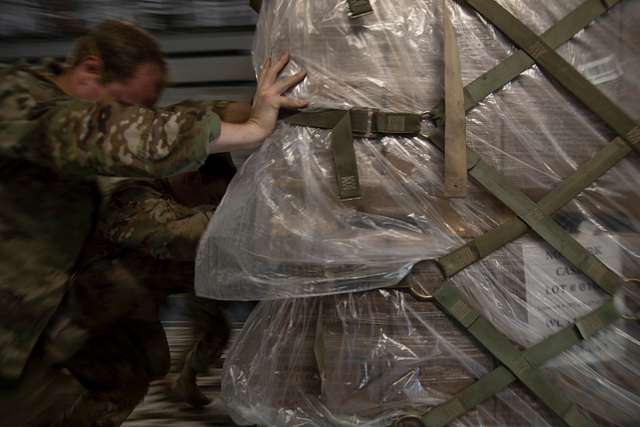
The August 4, 2020 ammonium nitrate explosion in the port of Beirut at Hangar 12 (a warehouse), was so powerful that it shook buildings 100 miles away in Cyprus and registered on regional seismographs.22 [See the video report by Australian Broadcasting Corporation and a June 2021 World Bank report to gain perspective on the explosion’s human and economic impacts.]
Open-sourced Forensic Architecture reported its detailed fact-finding and spatial analysis of the Beirut port explosion, below:
Taking the Forensic Architecture digital presentation and its cited open sources as true and accurate, Hangar 12 in Beirut’s port was transformed into a massive building-sized bomb. More questions than answers remain in understanding:
(1) How and when the fire was ignited;
(2) The cause of a hole in the warehouse necessitating a welding repair speculated by some to be the cause of the fire; when the hole was made, its handling, and how long the hole was there before it was repaired;
(3) Who ordered the hole repaired, who repaired the hole, and the background information and connections of the employees and employers involved in repairing the hole; evidence of an actual repair, and whether the crew repairing the hole was informed of the contents of Hanger 12;
(4) The course, behaviors, conditions, actions, statements, timing, and abandonment of the ammonium nitrate shipment on the MV Rhosus at the port of Beirut;
(5) How, when, and by whom fireworks, slow burning fuse spools, tires, and other chemicals came to be stored in Hangar 12 with the 2750 tons of ammonium nitrate.
If as the port manager said, the welding work at Hangar 12’s door on August 4, 2020 was done at 12 noon, and the fire brigade was called-in at about 5:55 PM EEST, how could the welding work have started the fire?
Assuming the port’s general manager Hassan Koraytem was accurate and honest in his facts, investigators would need to know how long the welding job lasted; how long the smoke was visible before the firefighters were called; and how long a spark can smolder before igniting fire inside a hangar without putting off smoke visible to the surrounding port and city. Surveillance cameras with time and date stamps, if any were in operation on the driven route to, and surrounding Hangar 12, might help determine if and when the work crew arrived and left, and when smoke was first noticeable before the fire brigade responded.
“State Security,” per port manager Koraytem had asked the port’s management to repair a door on Hangar 12. Who at state security contacted port management? How did that order pass through the chain of command at State Security? Was the repair crew briefed on the explosive danger in Hanger 12’s contents? And who were the workers who repaired the hole? What were their backgrounds and connections?
The hole is another concern. What caused the hole in the warehouse, and when? How old was it? Were there photos taken of the hole? With a hole in the warehouse, a bad actor could have entered before the hole was discovered, or before the repair crew got to it. When the hole was discovered and reported, was a walk-through of Hangar 12 conducted to investigate whether any contents of the warehouse had been removed, disturbed, or tampered with? Were any sentries assigned to guard the warehouse until the repair was done? If not, why not? Were any security cameras monitoring Hangar 12 over time to indicate how and when the hole occurred? If so, were the digital recordings preserved, saved, or backed-up?
The Rhosus, Russia, Cyprus, East Ukraine, & Mozambique: Since publication of the Forensic Architecture video, further investigative reporting traced the massive ammonium nitrate stores in Hangar 12 in the Port of Beirut to the Russian-leased, directed, and abandoned MV Rhosus. The Rhosus was, by appearances, a Mozambique-bound, Moldavan-flagged, Russian skippered, Ukrainian crewed, and safety-challenged cargo vessel. The Independent reported:
Grechushkin had to know of the vessel’s previous impoundment in Spain, its loss of crew in Tuzla, Turkey due to his alleged failure to pay costs, and the hole in its hull that likely led to its sinking in the Beirut port in 2015. It is less clear why the Rhosus cleared Athens’ Piraeus port in Athens, where it remained 25 days before sailing to Beirut with a hole in its hull. It is not clear which pier at Piraeus port the Rhosus spent time at, but China did control franchising rights at one pier there by 2013.
It is clear that Grechushkin and Prokoshev did everything financially and physically possible to make sure the Rhosus’ shipment of 2750 tons of high-density ammonium nitrate could not proceed from Beirut’s port to the Suez Canal, and onto Mozambique. The decisions to put a 2750-ton load of a compound as dangerous as high-density ammonium nitrate onto a poorly-maintained ship like the Rhosus; starve the ship and crew of funds needed to repair and maintain the ship; and direct them to try to load heavy machinery the ship could not handle at the Beirut port appears to be sabotage and abandonment by design at the Beirut port.
Adding to this line of thought is that while the Rhosus’s Captain Prokoshev claimed that Igor Grechushkin was greedy, cheap, and had abandoned and ripped-off the Rhosus and crew in 2013, in 2014 Grechushkin reportedly “resurfaced” to pay for the return home of the Russian and Ukrainian crew after a Lebanese judge ordered their release on compassionate grounds in 2014. In retrospect, Grechushkin’s act could be interpreted as returning material witnesses to Russian or East Ukrainian jurisdiction or control before non-credible aspects of Captain Prokoshev’s accounts emerged; or before the Odessa-based “charity” “Assol Foundation” that publicized the danger to the crew of being held on the Rhosus (calling it a “floating bomb”), could be fully investigated.
Indeed, the NY Times later interviewed Captain Prokoshev by phone from the Russian Black Sea resort of Sochi. Prokoshev told the Times he was “horrified” about the “accident,” with the Times showing little interest as to how the apparently poorly paid, former Soviet sailor could afford Sochi.
Of interest is that the last four letters of the Cypriot town Limassol coincide with the Odessa-based sailor-advocacy “charity” of various alias-monikers referenced in Russian media sites as the Assol Foundation, the Assol Sailor Assistance Fund, etc..
Originally, the Rhosus’s explosive cargo was by appearances destined for Biera, Mozambique for delivery to Fábrica de Explosivos Moçambique (FEM). In early reports, an anonymous source at FEM denied that the shipment was paid for by the company. In later reporting by the NY Times:
The Independent’s two reports of August 5th and 7th, 2020, and a number of others thereafter, highlighted the extreme danger surrounding the Rhosus cargo and its handling, yet queried two maritime shipping experts, Mikhail Voytenko, the editor of Maritime Bulletin and Natalya Klamm, Director of the Odessa-based Assol foundation, respectively, who together shifted attention from the behavior of the Rhosus’s owner and charterer, Igor Grechushkin and from the Rhosus’s captain and crew, toward Georgian and Lebanese port authorities, Lebanese politicians, and a narrative about lack of financing and corrupt practices in the global shipping trade.23
Mikhail Voytenko has described himself as a “Russian, professional merchant marine navigator, by education and former experience,” and Natalya Klamm’s Odessa-based Assol Foundation is reportedly a charity aiding Ukrainian sailors in trouble, coincidentally, in areas of acute Russian geopolitical interest. Few online sources cite Assol Foundation activities, also referred to as the “Assol Sailors’ Support Foundation in Odessa,” by Russian state media outlet TASS on August 5, 2020. Note the political activist tone in the photo below, citing the “Assol Foundation” with the photo’s credit at the Marine Insight website, suggesting a nationalistic activist approach for the Russian Captain and Ukrainian crew rather than a professional insurer’s approach.
Uncertain is whether many of the Ukrainian crew members on the Rhosus, the Ruta, and the Captain Khayyam were pro-Russian irredentists from East Ukraine and loyal to Moscow, with the Ukrainian advocacy organization’s Odessa address designed to put a Ukrainian stamp on Russian-controlled shipping adventures. That is not certain, but worth further research by investigators of the Beirut blast of August 4, 2020.
As for timing, the MV Rhosus ostensibly carried massive amounts of ammonium nitrate from Georgia to Mozambique in 2013-14, a time when Russian covert operatives had been flooding Crimea and pro-Russian crowds rioted to free jailed pro-Russian separatists in Odessa, the base for Assol Sailor Assistance Fund. Such ties and timing lend skepticism to the Independent’s sources’ rationales shifting attention away from the Russian owner, captain, and East Ukrainian crew of the Rhosus. Also, in 2014, Russian ministers were warning the Obama Administration not to sanction Russia for annexing Crimea, threatening asymmetric responses if it did so.
Reuters in 2020, investigating the question of ownership of the MV Rhosus ammonium nitrate shipment found a series of red flags:
Ultimately, Reuters’ scrutiny returned to Igor Grechushkin of Cyprus after other parties linked to the shipment “denied knowledge of the cargo’s original owner or declined to answer the question,” including the Rhosus’s captain, the Georgian fertilizer maker Rustavi Azot, and the Mozambican firm that agreed to pay for it on arrival.
The Mozambique debt crisis apparently caused the IMF to take a step back from Mozambique, after which the Russian Federation’s role offering energy, financial, and mining expertise became more prominent there. Russian state oil companies are deeply interested in Mozambican Liquified Natural Gas projects in Northern Mozambique, however, the rise of ISIS in Mozambique had made Russia’s security capabilities more important to the Mozambican government and economy in recent years.25 Wagner Group, Russia’s worst kept secret as a state-linked mercenary firm undertook anti-ISIS security efforts to protect Russian diplomatic and business interests in Mozambique.
OCCRP reported that the current first family of Mozambique may also have been ensnared by more nefarious ties than hiding debt, to a Portuguese firm investigated for arms and terrorist financing intertwined with the explosives company that ordered the Ammonium Nitrate that blew up Beirut on August 4, 2020:
However, more recently, after Russia’s mercenary firm Wagner Group suffered setbacks in protecting Mozambican LNG projects from ISIS insurgents, Mozambique has sought training for its military from the U.S.26
The Cyprus interconnections with entities involved in arms, explosives, and money laundering include past conduits for funding Iranian-backed Lebanese Hezbollah. Current reports are that Iran had funded anti-U.S. terrorist groups in Somalia including al-Shabab, some of whose followers incrementally moved South along the East African coast to Tanzania, and Mozambique after their Salafist leader Aboud Rogo Mohammed was killed in Kenya in 2012.27 Of concern in these murky interrelationships are past Soviet practices in state sponsored terrorism leveraged against emerging nations with coveted resources creating crises that make Russian security contracts, weapons sales, petroleum licenses, and mining agreements more permissive to secure those states yet ‘help’ those states pay for Soviet-Russian services and weapons.
Post-Explosion Events and Updates
After the Beirut port explosion, the severity of Lebanon’s national economic crisis was rated among the three worst in the world in over a century. With over 250,000 people displaced due to structural and environmental risks in Beirut, and the port at low capacity, food security appeared in doubt. The port of Tripoli, Lebanon, managed by Russia’s Rosneft, took on traffic interrupted by the Beirut port’s explosion.
Many are leaving Lebanon following the Beirut port explosion, including professionals and companies, worsening Lebanon’s brain-drain.
Post-explosion, the Lebanese are in dire need for help from all sides. With global demand for oil and gas driving prices up and Lebanon in danger of being a failed-state, Lebanon and Israel have found new incentives to restart negotiations to resolve their maritime border dispute so they can get busy producing oil and gas with less risk.
Russia, France, Iran, the U.S. and others have offered financial and investigative support. By invitation, France and the U.S. had been investigating the explosion and its causes in the Fall of 2o2o, with European sources leaning toward calling the blast an accident, and the U.S. having reached no conclusion one way or the other by October 2020.
The Russian state’s activity in Lebanon appears to follow a pattern of crisis-opportunism and or creation, patrimony, and incremental seizure of controlling leverage and influence over corrupt ruling elites in emerging nations facing dire situations. These behaviors involve varied strategies for securing usefulness, wealth, and resources from the states patronized, influenced, or controlled. The Russian state and private security presence is one line of business laying the foundations for future military rights and privileges inside influenced or controlled countries.
The Chinese activity in Lebanon and Syria fit the Chinese pattern of filling economic vacuums and turning them into mercantilist networks leading back to China that enrich Beijing while asserting a military and intelligence presence to influence compliance and protect those interests.
Russia and China seek control over the Mediterranean region as a gateway to the Eastern Hemisphere’s markets, resources, and strategic locations, including Eurasia, the Mideast, and Africa. They seek strategic military advantage in tandem with mercantilist economic expansion. Their activities in Lebanon and Syria, or the Syrian-Track, aka the BRI or Silk Road, appear to be motivated by a will to maintain control over the ruling regimes of both countries.
The Beirut blast, whether it became a case of crisis-opportunism exploited by Russia, or engineered by Russia, is likely being used as a tool to break the logjam that Caesar Act sanctions put on Syrian reconstruction via Lebanon, and to incrementally acquire economic and military control over both Lebanon’s and Syria’s ports, perhaps divvying-up control and exploitation with China whose financing is needed to sustain Russia’s strategy between oil booms.
Russia’s leadership and its loyal foot soldiers are in a Stalin-glorifying phase in their history, showing themselves willing to engage in state terror, incremental aggression, doomsday weapons, development of first strike weapons, use of criminal proxies, and international assassination. Stalinist behaviors cannot be ruled out in possible interpretations of events advantaging Putin’s Russia that follow the history of ‘going big or going home’ and adhering to the saying attributed to Joseph Stalin: “The death of one man is a tragedy. The death of millions is a statistic.”
This is not to say that there is proof that Russia’s, and to some extent, China’s services shaped and moved the forces that blew up the Beirut port as if they had done it themselves, or even did it themselves, however, in 2014 and following, Russia’s services were alleged to be involved in a spate of explosions at a Czech and Ukrainian ammunition depots, having also performed bold, multiple high-profile assassinations in the U.K., at home and elsewhere. In the case of nation states with deep resources showing patterns of internationally aggressive conduct, obtaining smoking gun evidence that the nation committed an act of strategic terror is an unlikely occurrence.
However, denying it out of hand while a pattern of terroristic events advantaging the aggressive nation continue to occur at increasing distances outward from its territory is at best self-blinding appeasement that enhances the fund of intended coercive fear-power the suspect state has amassed that it may take what it wants.
Endnotes
Introduction
¹Ferguson, Sarah. “UNICEF USA BrandVoice: Ramadan In Lebanon: After A Deadly Explosion, Trauma Lingers.” Forbes. Forbes Magazine, April 23, 2021. https://www.forbes.com/sites/unicefusa/2021/04/23/ramadan-in-lebanon-after-a-deadly-explosion-trauma-lingers/?sh=6daa57c01d38; and John, Tara, Melissa Macaya, Mike Hayes, Adam Renton, Zamira Rahim, and Ed Upright. “Lebanon’s Capital City Rocked by Explosion.” CNN. August 06, 2020. Accessed August 24, 2020. https://www.cnn.com/middleeast/live-news/lebanon-beirut-explosion-live-updates-dle-intl/h_5153adf93882736fc4999b7d0f46a8ac.
3 Bazzi, Mohamad. “The New Lebanon Is the Old Lebanon.” The New York Times. The New York Times, January 29, 2020. https://www.nytimes.com/2020/01/29/opinion/lebanon-crisis.html;
4 Alfred, Charlotte. “Dangerous Exit: Who Controls How Syrians in Lebanon Go Home.” Refugees. August 16, 2018. Accessed September 11, 2020. https://www.newsdeeply.com/refugees/articles/2018/08/08/dangerous-exit-who-controls-how-syrians-in-lebanon-go-home; and Reidy, Eric. “Tripoli: The First Stop On The Refugee Trail To Greece.” HuffPost. April 08, 2016. Accessed September 11, 2020. https://www.huffpost.com/entry/tripoli-mediterranean-refugee-trail_n_5707fbc7e4b063f854df9632.
History of Chaos and Its Manipulation in Lebanon:
5 Mroue, Bassem. “Lebanon at 100: Upheaval, Crises, a New Prime Minister.” The Christian Science Monitor. August 31, 2020. Accessed September 11, 2020. https://www.csmonitor.com/World/2020/0831/Lebanon-at-100-Upheaval-crises-a-new-prime-minister; See also: Fisk, Robert. “Clues to the Lebanese Revolution Are All Contained in Country’s Modern History.” The Independent. January 30, 2020. Accessed September 11, 2020. https://www.independent.co.uk/news/world/middle-east/lebanon-revolution-beirut-history-france-protests-a9303491.html.
Alternatives to U.S. Democratic alliance, friendship, partnership:
6 Gates, Robert Michael. “Chapter 1: The Symphony of Power.” In Exercise of Power: American Failures, Successes, and a New Path Forward in the Post-Cold War World, 47-49. New York: Alfred A. Knopf, 2020 (Robert Gates describes the potent ideological attack on American constitutional democracy with Russia’s Putin calling the liberal idea “obsolete” and Xi Jinping offering China’s authoritarianism as a stronger model for developing and organizing the emerging nations of the world).
Finance:
7 Shepherd, Christian. “China’s Xi Pledges $20 Billion in Loans to Revive Middle East.” Reuters. July 10, 2018. Accessed October 27, 2020. https://www.reuters.com/article/us-china-arabstates-idUSKBN1K0072
Arms:
8Bar’el, Zvi. “Russia to Gift Lebanon with Arms, Military Supplies to Bolster Army.” Haaretz.com. January 11, 2018. Accessed October 16, 2020. https://www.haaretz.com/1.5140463; More comprehensively: Borshchevskaya, Anna, and Hanin Ghaddar. “How to Read Lebanon’s Acceptance of Russian Military Aid.” The Washington Institute, December 7, 2018. https://www.washingtoninstitute.org/policy-analysis/how-read-lebanons-acceptance-russian-military-aid.
Russia and China’s Sovereign Company Vaccine Influence:
9 Geddie, John, and Aravindan Aradhana. “China in Talks with WHO over Assessing Its COVID-19 Vaccines for Global Use.” Reuters. October 06, 2020 (China has at least four experimental vaccines in the final stage of clinical trials – two are developed by state-backed China National Biotec Group (CNBG), and the remaining two are from Sinovac Biotech SVA.O and CanSino Biologics 6185.HK688185.SS respectively..They are tested in such countries as Pakistan, Indonesia, Brazil, Russia and the United Arab Emirates.) Accessed October 06, 2020. https://www.reuters.com/article/us-health-coronavirus-who-china-idUSKBN26R19B; Russian Sputnik V Vaccine: Chander, Vishwadha, Dania Nadeem, and Mrinalika Roy. “FACTBOX-Russia Strikes Global Deals to Make, Sell Coronavirus Vaccine.” Reuters. October 02, 2020 (Russia has signed manufacturing and supply agreements for its COVID-19 vaccine candidate with at least 10 countries in Asia, South America and the Middle East..). Accessed October 06, 2020. https://www.reuters.com/article/health-coronavirus-russia-vaccine-idUSL4N2GS24X; Also: Burki, Talha Khan. “The Russian Vaccine for COVID-19.” The Lancet. September 4, 2020. Accessed October 06, 2020. doi:https://doi.org/10.1016/S2213-2600(20)30402-1.
Russian and Chinese Ambitions in Lebanon and Security Arrangements:
10 Tashjian, Yeghia. “Russia’s Interests in Lebanon: Fulfilling a Middle Eastern Dream.” The Armenian Weekly, June 3, 2021. https://armenianweekly.com/2021/06/02/russias-interests-in-lebanon-fulfilling-a-middle-eastern-dream/; Melamedov, Grigory. “Why Russia Wants Lebanon.” Middle East Forum. Middle East Forum, 2020. https://www.meforum.org/60026/why-russia-wants-lebanon; And see: Daly, John C. K. “Russia and Lebanon Drafting Agreement for Increased Military Cooperation.” Jamestown. February 26, 2018. Accessed October 16, 2020. https://jamestown.org/program/russia-lebanon-drafting-agreement-increased-military-cooperation/
Russia in Lebanon, Africa, Mediterranean: Lebanon:
11 Samaha, Nour, Sajad Jiyad, Adam Baron and Monder Basalma, Nicholas Danforth, Aron Lund, Dina Esfandiary, and Nadwa Al-Dawsari. “Is Lebanon Embracing a Larger Russian Role in Its Country?” The Century Foundation, April 22, 2019. https://tcf.org/content/commentary/lebanon-embracing-larger-russian-role-country/ Africa: Schmitt, Eric, and Thomas Gibbons-neff. “Russia Exerts Growing Influence in Africa, Worrying Many in the West.” The New York Times. The New York Times, January 28, 2020. https://www.nytimes.com/2020/01/28/world/africa/russia-africa-troops.html. Mediterranean: Grady, John. “Panel: Russian Navy Expanding Presence in the Mediterranean Sea, Africa.” USNI News, April 30, 2021. https://news.usni.org/2021/04/30/panel-russian-navy-expanding-presence-in-the-mediterranean-sea-africa. Syria: Western view: Weiss, Andrew S. “Managing Russia’s Ambitions – From Hardware to Holism: Rebalancing America’s Security Engagement With Arab States.” Carnegie Endowment for International Peace, May 18, 2021. https://carnegieendowment.org/2021/05/18/managing-russia-s-ambitions-pub-84528. Qatari state press, Bulgarian writer Lens: Petkova, Mariya. “What Has Russia Gained from Five Years of Fighting in Syria?” Middle East | Al Jazeera. Al Jazeera, October 1, 2020. https://www.aljazeera.com/features/2020/10/1/what-has-russia-gained-from-five-years-of-fighting-in-syria
China-Lebanon et al.:
12 Taleb, Wael. “China Emerges as Potential Investor as Lebanon Runs Low on Options.” Al. July 24, 2020. Accessed October 27, 2020. https://www.al-monitor.com/pulse/originals/2020/07/lebanon-china-money-investment.html; And: Mroue, Bassem. “Lebanon Looks to China as US, Arabs Refuse to Help in Crisis.” The Washington Post. July 15, 2020. Accessed October 27, 2020. https://www.washingtonpost.com/business/lebanon-looks-to-china-as-us-arabs-refuse-to-help-in-crisis/2020/07/15/52a013f4-c661-11ea-a825-8722004e4150_story.html;
China-Africa: Gebre, Samuel, and David Wainer. “Africa News: China Steps Up Pressure Over Ethiopia Hydro Power.” Bloomberg.com. May 21, 2020. Accessed October 27, 2020 (Excerpt: China is Ethiopia’s biggest trading partner… estimated to have provided more than $16 billion of loans to the Horn of Africa nation, including a $1.2 billion credit to build transmission lines that will link to the plant. The electricity will help power a Chinese-funded railway that connects landlocked Ethiopia to ports in neighboring Djibouti.) https://www.bloomberg.com/news/articles/2020-05-21/diplomatic-pressure-mounts-on-ethiopia-over-filling-of-giant-dam
Arctic: Staff. “US, Russia and China Seek Edge as Battle for Arctic Heats Up.” Nikkei Asia. May 18, 2021. https://asia.nikkei.com/Politics/International-relations/US-Russia-and-China-seek-edge-as-battle-for-Arctic-heats-up; U.S. Navy Secretary’s view: Staff. “US Awakens to Risk of China-Russia Alliance in the Arctic.” Nikkei Asia. Nikkei Asia, May 23, 2020. https://asia.nikkei.com/Politics/International-relations/US-awakens-to-risk-of-China-Russia-alliance-in-the-Arctic; Viewpoint: UiT The Arctic University of Norway Staff: Science X. “An Agile Superpower: China’s Various Roles in Africa and the Arctic.” Phys.org. Phys.org, March 18, 2021. https://phys.org/news/2021-03-agile-superpower-china-roles-africa.html
Middle East: Fraser, Gen. Douglas. “Iran-China-Russia Axis Threatens US and Israeli Interests.” Commentary. The Defense Post, October 14, 2020 (20 and 25 year strategic cooperation agreements between Moscow and Beijing respectively, with Iran). https://www.thedefensepost.com/2020/10/14/iran-china-russia-axis/ SCO: Economy, Elizabeth C., and William Piekos. “The Risks and Rewards of SCO Expansion.” Council on Foreign Relations. Council on Foreign Relations, July 7, 2015. https://www.cfr.org/expert-brief/risks-and-rewards-sco-expansion
Military Axis: Isachenkov, Vladimir. “Putin: Russia-China Military Alliance Can’t Be Ruled Out.” AP NEWS. Associated Press, October 22, 2020. https://apnews.com/article/beijing-moscow-foreign-policy-russia-vladimir-putin-1d4b112d2fe8cb66192c5225f4d614c4 (Putin admitting joint military cooperation and shared military information and refusing to rule out alliance).
Israel’s Recalibration:
13 Vohra, Anchal. “Israel and the Emirates Are the Middle East’s New Best Friends.” Foreign Policy. Foreign Policy, January 1, 9366. https://foreignpolicy.com/2021/01/11/israel-and-the-emirates-are-the-middle-easts-new-best-friends/
14 Jakes, Lara, Isabel Kershner, Aida Alami, and David. “Morocco Joins List of Arab Nations to Begin Normalizing Relations With Israel.” The New York Times. The New York Times, December 10, 2020. https://www.nytimes.com/2020/12/10/world/middleeast/israel-morocco-trump.html.
15 Fabian, Emanuel, Aaron Boxerman, Jacob Magid, Aviva and Shmuel Bar-Am, Marshall Weiss, Alex Galbinski, Afp, et al. “Report: Ethiopia Arrests 16 in an Iranian Cell Planning Attack on UAE Embassy.” The Times of Israel, February 5, 2021. https://www.timesofisrael.com/report-ethiopia-arrests-16-in-an-iranian-cell-planning-attack-on-uae-embassy/; See also: Zaher, Hassan Abdel. “Concerns Mount in Egypt as Israel Boosts Ties with Ethiopia: Hassan Abdel Zaher.” AW, July 20, 2019. https://thearabweekly.com/concerns-mount-egypt-israel-boosts-ties-ethiopia.
China’s BRI:
16 Hillman, Jennifer, and David Sacks. “How the U.S. Should Respond to China’s Belt and Road.” Council on Foreign Relations. Council on Foreign Relations, March 2021 (Stating obvious: If unanswered, China’s BRI would give it “greater influence over countries’ political decisions, and acquire more power-projection capabilities for its military.”) https://www.cfr.org/report/chinas-belt-and-road-implications-for-the-united-states/; Also: “China Will Build String of Military Bases around World, Says Pentagon.” The Guardian. Guardian News and Media, May 3, 2019. https://www.theguardian.com/world/2019/may/03/china-will-build-string-of-military-bases-around-world-says-pentagon.
Russia-Syria-Lebanon-Hezbollah
17 Russian International Affairs Council, trans. “Reconstruction of Syria: Visions from Russia and the EU.” YouTube, February 19, 2020. https://youtu.be/8AAKBAX4SyU (Minute mark 31-36: Aleksander Aksenenok, RIAC Vice President, Ambassador Extraordinary and Plenipotentiary of the Russian Federation claiming that E.U. has made reconstruction process too political, with strict political and humanitarian conditions on aid to the Assad regime but opening door to possible changes after May 2021 elections in Syria), except, see more recently that a ‘symbolic’ election showed Assad firmly in power with little hope of reforms: Sherlock, Ruth. “Syrian Election Shows The Extent Of Assad’s Power.” NPR. NPR, May 27, 2021. https://www.npr.org/2021/05/26/1000503282/syria-presidential-election-2021-assad-fourth-term; See also, the U.S. Caeasar Act sanctions’ effect: Khalel, Sheren. “What’s the Caesar Act and How Will New US Sanctions Impact Syria?” Ya Libnan, June 18, 2020. https://yalibnan.com/2020/06/18/whats-the-caesar-act-and-how-will-new-us-sanctions-impact-syria/.
18 id. at 5: Mroue, Bassem. “Lebanon Looks to China as US, Arabs Refuse to Help in Crisis.” The Washington Post.
19 Reuters. “Netanyahu Warns Hezbollah Against Playing With Fire After Frontier Incident.” U.S. News & World Report. U.S. News & World Report, July 27, 2020. https://www.usnews.com/news/world/articles/2020-07-27/exchange-of-fire-across-israel-lebanon-border-israeli-media-reports.
20 Dagher, Sam, Aya Majzoub, and Christophe Abi-Nassif. “The US Must Remain Engaged in Lebanon or Risk Russian and Chinese Gains.” Middle East Institute, March 18, 2020. https://www.mei.edu/publications/us-must-remain-engaged-lebanon-or-risk-russian-and-chinese-gains.
21 Id. at 10: Daly, John C. K. “Russia and Lebanon Drafting Agreement for Increased Military Cooperation.” Jamestown. February 26, 2018. https://jamestown.org/program/russia-lebanon-drafting-agreement-increased-military-cooperation/ Also: Id. at 8: Bar’el, Zvi. “Russia to Gift Lebanon with Arms, Military Supplies to Bolster Army.” Haaretz.com, and See: Adamsky, Dmitry. “Russia and the Next Lebanon War.” Foreign Affairs, August 14, 2019. https://www.foreignaffairs.com/articles/israel/2017-10-06/russia-and-next-lebanon-war.
Explosion and Investigations
22 Hernandez, Marco. “How Powerful Was the Beirut Blast?” Reuters. Thomson Reuters, August 14, 2020. https://graphics.reuters.com/LEBANON-SECURITY/BLAST/yzdpxnmqbpx/.
23 Carroll, Oliver. “Igor Grechushkin: Who Is the Russian Businessman Who Owned the ‘Floating Bomb’ in Beirut’s Port?” The Independent. Independent Digital News and Media, August 7, 2020. https://www.independent.co.uk/news/world/europe/igor-grechushkin-beirut-port-russia-floating-bomb-ammonium-nitrate-a9657816.html Also: Carroll, Oliver. “What Caused the Beirut Explosions and Is Russia Connected to the ‘Floating Bomb’ Cargo?” The Independent. Independent Digital News and Media, August 5, 2020. https://www.independent.co.uk/news/world/middle-east/beirut-explosion-port-ammonium-nitrate-floating-bomb-russia-lebanon-a9654906.html.
24 Vasilyeva, Maria, Lisa Barrington, and Jonathan Saul. “Who Owned the Chemicals That Blew up Beirut? No One Will Say.” Reuters. Thomson Reuters, August 11, 2020. https://www.reuters.com/article/us-lebanon-security-blast-ship-insight/who-owned-the-chemicals-that-blew-up-beirut-no-one-will-say-idUSKCN2571CP.
25 Nhamirre, Borges. “Russia Boosts Military Cooperation With Mozambique After Attacks.” Bloomberg.com. Bloomberg, March 7, 2018. https://www.bloomberg.com/news/articles/2018-03-07/russia-boosts-military-cooperation-with-mozambique-after-attacks.
26 John Vandiver. “US Special Operations Forces Train Mozambique Troops to Counter ISIS Threat.” Stars and Stripes, March 16, 2021. https://www.stripes.com/news/africa/us-special-operations-forces-train-mozambique-troops-to-counter-isis-threat-1.665958#:~:text=S.%20special%20operations%20troops%20have%20launched%20a%20mission,concerns%20about%20escalating%20violence%20by%20Islamic%20State%20militants.
27 Clark, Colin. “The Evolution and Escalation of the Islamic State Threat to Mozambique.” Foreign Policy Research Institute, April 19, 2021. https://www.fpri.org/article/2021/04/the-evolution-and-escalation-of-the-islamic-state-threat-to-mozambique/.
Setup: In Q1 February, Tesla bought 1.5 billion USD in Bitcoin, sold 10% of that for a profit, announced Tesla would accept Bitcoin for cars, then announced on May 12th on Twitter that Tesla will suspend its acceptance of Bitcoin for the negative environmental impact of its mining operations. This, while asking Tesla followers whether Tesla should accept Dogecoin for Teslas instead.
Question: Yet Tesla had to be aware of the climate costs of Bitcoin mining before all this. What else is up?
And this week, April numbers showed that Tesla’s China sales dropped 27% from March to April. Tesla has also balked this week at acquiring more land for its Shanghai Tesla plant citing the 25% Trump tariffs after April’s numbers showed a drop in Chinese sales of 27% from March 2021.
Would it be cynical to suggest that that Tesla may have bought 1.5 billion in Bitcoin as a negotiating token with China to avoid the negative treatment some other foreign companies had received? This on the premise that China commands influence and tax power over the largest Chinese Bitcoin mining operations in the world no matter where they base themselves. Elon Musk’s influence over Bitcoin prices could therefore affect China’s bottom line. In fact, China has quickly announced crackdowns on Bitcoin mining after its dominance and climate impact became well-known, despite the deputy governor of The People’s Bank of China (PBoC) referring to it as an alternative investment as recently as mid-April 2021. Tesla appears to be hanging onto its Bitcoin despite suspending it for transactions, possibly signaling its intent to keep it as a bargaining chip and for future use. Neither by offshoring Bitcoin mining does China necessarily relinquish interests in the Bitcoin mined or influence over its holders.
When it appeared Beijing may have influenced Chinese consumers to slow down on buying Teslas on spying and other pretexts (Huawei retaliation?) did that prompt Musk to play hardball, stop accepting Bitcoin for Teslas, and freeze further investment in Chinese expansion? Was Musk’s emphasis in his Tweet on the environmental impact of Bitcoin mining a geopolitical leadership-PR counterpunch to China?
Some may recall Peter Thiel warning that China might be using Bitcoin as a weapon against the U.S. dollar. Although Thiel is a biased party, he makes a good point that China’s lead in Bitcoin mining is not only an economic tool of wealth absorption, but a possible weapon for use against the U.S. Dollar reserve currency, and a potential economic weapon via cryptocurrency price manipulation negatively impacting non-Chinese investors.
Musk may have used his rockstar influence to leverage China’s Bitcoin weight against Beijing, at one point reaching a 300 Billion USD swoon in cryptocurrency markets following his Tweet. With such high exposure to China, Musk’s cryptocurrency decisions may be a form of self-insurance against the unpredictable moods of an unresolved trade war.
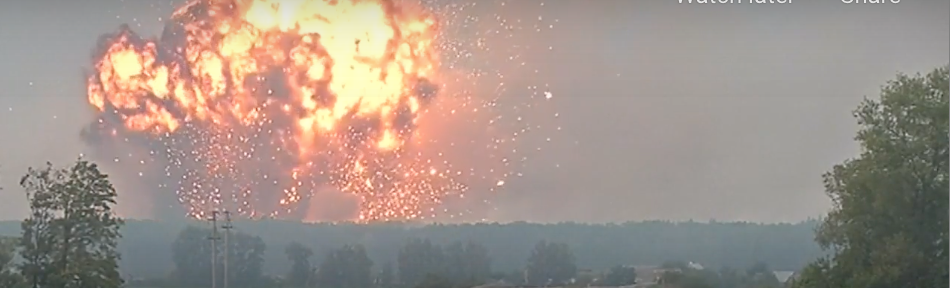
Some video documentaries and discussions of the tactically-significant ammo depot explosions in the Czech Republic and Ukraine follow:
Czech Republic Ammunition Depot Explosion, October 16, 2014
Balakleya, Ukraine, Ammo Depot Explosion, March 2017
Kalynivka, near Vinnytsia, Ukraine, September 2017
Druzhba, Chernihiv Region, Ukraine, October 2018
Contextual, Tactical Implications:
The fires, massive explosions, and stray missile activity at the ammo depots in the Czech Republic in 2014 and in Ukraine between 2015-2018 destroyed large stores of shells, rockets, and missiles held by or destined for the Ukrainian military. Some of the depots reportedly contained older munitions and were not well manned.
In December 2020, Russian President Vladimir Putin told Russian journalists that he would increase aid to the areas supporting Russian speaking insurgents and irredentist forces in Ukraine, suggesting that the seemingly innocuous expression of intent to help the “people” in the Donbas may have signaled a higher aggression posture preparing for this month’s staged invasion force.
Basic Recommendations
(1) Ukraine, European, and Eurasian democracies must harden facilities storing munitions, heavy weaponry, light weaponry, aircraft, energy, fuel, chemical, and other material supply chains against insider threats, covert attacks, and clandestine sabotage;
(2) When hacking surveillance and reconnaissance activity increases, implement extra physical security and vigilance at military bases, depots, throughout the supply chain, armories, and related sites. This should include insider checks, K9 bomb detection patrols, and unannounced inspections;
(3) Assemble and train special base, depot, supply chain, storage and armory security units with combat and technical experience and capability, and assign them to prioritized installations;
(4) Assemble and train rapid materiel removal and temporary storage teams for special circumstances;
(5) Decentralize ammunition, munition, weapons, heavy weapons, and other military supplies so that they are movable, changeable, and support a range of Ukrainian military positions and capabilities focusing on preserving stocks and providing for continuous supply, resupply, and replenishment;
(6) Build-up communications monitoring and decrypting capabilities;
(7) Create anti-drone buffer zones surrounding all military supply chain sites, barracks, stations, depots, and communications facilities;
(8) Apply faraday protection for critical circuitry, communication areas, and other operational spaces relied upon by Ukrainian command, control, and communications;
(9) Create inspection checklists and inspection teams for insuring the maintenance, training, vetting, and execution desired. Utilize snap inspections as motivation and as a countermeasure opportunity where available;
(10) Identify Russian and proxy hackers used to support or execute sabotage. Eliminate the means, anonymity, and secrecy by which they operate;
(11) Seek detente via diplomacy while bringing Russian sabotage activity before the U.N. and other international bodies, especially when such aggression results in loss of human life, economic opportunity, violates nation state sovereignty, and causes related instability in the region.
Conclusion
The defense force that handles military materiel, supply chains, munitions, weapons, and communications in lax, non-serious, and wasteful ways is self-defeating.
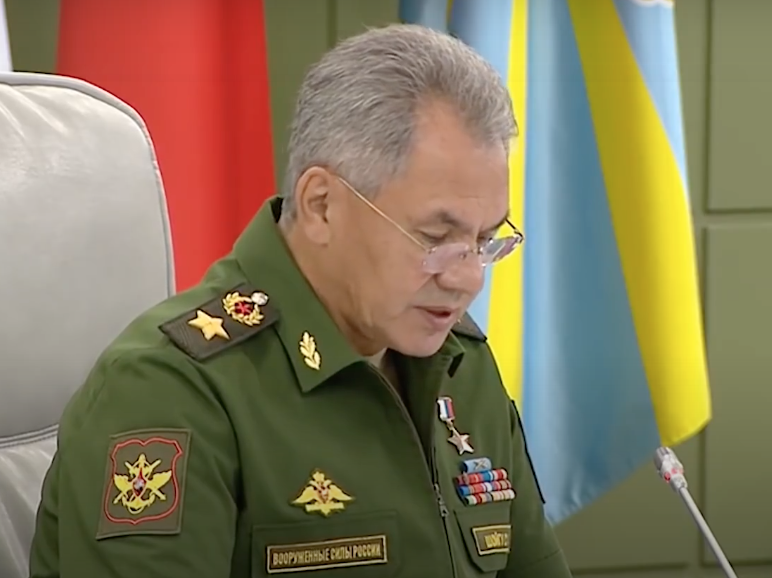
Vladimir Putin’s military build-up on the Ukraine border and partial pull-back today, combined with visible anger in his red-line rhetoric threatening harsh punishment for those who disrespect Russia’s security interests showed signs of impulsiveness in one inexperienced at commanding military forces. It was interesting that Russian Defense Minister Sergei Shoigu signaled the pullback.
A breakthrough force with the look of a Spring offensive, absent a clearly defined, publicly-supported security interest opens the Russian military to risks of escalation, entanglement, mission creep, overextension, and blame for an unnecessary Ukrainian and European land war. Such a war would awaken insurgent opportunism in the Caucasus, Siberia, the Near East, Mideast, and North Africa.
Evidence of Russian encirclement of Europe puts an imperial stamp on Putin’s activities in both hemispheres (not agreeing with every conclusion of the linked NR piece). The overall effect is destabilizing. Consistent with this trend, in December 2020, Vladimir Putin telegraphed his intention to send increase aid to Russian speaking areas in Eastern Ukraine as if these were Russia’s territories, a provocation against Kyiv and Ukraine’s sovereignty, leading to current tensions.
In view of the above, this latest incident at the Ukraine border appears to have been impulsive on Putin’s part, acting forcefully without thinking through the unintended consequences for Russia’s real security interests versus Putin’s ideologic and legacy-oriented motives. Defense Minister Shoigu may have alerted Mr. Putin to the military risks of his target-fixation on redressing past grievances instead of dealing with today’s reality.
Finally, Putin’s decisions leading to this Spring 2021 incident contradicts Moscow’s narratives that NATO is obsolete and Putin’s pretenses to respecting national sovereignty.
As authorities charge suspects in the January 6, 2021 Capitol riot and insurrection, the pipe bomber suspect recorded the night before remains a menacing question mark.
This source-linked analysis begins with observations, questions, and analysis of the actions of the suspected pipe bomber captured on select FBI-released video segments from the U.S. Capitol Hill neighborhood on the evening of January 5, 2021. It explores events, details, and actions in context as may lead to identifying the pipe bomb suspect.
The analysis then addresses the gray war effects of the pipe bombs placed outside the HQ’s of the RNC and DNC and found on January 6, 2021.
Capitol Hill Pipe Bomber Video Segments: January 5, 2021
This analysis is partly based on the embedded FBI-released video segments below. For brevity, it uses the words “suspect” and “he” without assuming gender:
Possible Dominant Hand: In all of the video captures seen above in which the pipe bomb suspect is carrying the backpack (thought to contain the pipe bombs), he uses his right hand in a straight-arm carry to his right side. Then, at the corner of Canal and South Capitol Street on Democratic National Committee HQ premises, the suspect sits on a park bench, sets down his backpack in front of him on the ground, and appears to pull an item from the backpack. He rises, holding a shiny object in his right hand, possibly a pipe bomb, while holding the backpack in his left hand, then sits down abruptly. That he drew the object out of the backpack with his right hand and switched to holding the pack with this left suggests he is right hand dominant. (More on this segment later).
South Capitol Street SE, Residential Sidewalk Near DNC Segment: Context and Details
Behavior / Backpack / Jeans / Glasses: The suspect first hesitates on the residential sidewalk (at Left from camera viewpoint), looks back where he came from; touches his glasses and face mask; then looks in the general direction of the camera in the parking lot across the street. He walks two more doors down the sidewalk L to R per camera view, then stops on the sidewalk in front of a house, sets the backpack on the sidewalk against a small retaining wall, and bends at the waist revealing a right-side rectangular patch on the back of his jeans. He appears to pull something from the pack (perhaps a cloth), takes-off his glasses, and stands up facing the camera again, cleaning his glasses using both hands, before replacing them on his face above his mask (which he does not remove). The suspect is gloved throughout. Backpack Detail: Fibers from the backpack, gloves, and or powders or residues adhered to them might have transferred from the backpack to rough textures on the sidewalk or retaining wall where the suspect set the backpack in this segment. Jeans Detail: Does the shape, size, and location of the patch on the back of the suspect’s trousers betray the brand?
Glasses / DNA: It isn’t clear the suspect cleans his glasses from necessity, but when he takes them off or cleans them, it is an opening for an eyelash, eyebrow, eye-rheum, dead skin, or dandruff to fall near to where he is standing. While chances are low in a public place with nearly three months passed by, the chances that another person would have stopped at that exact spot to clean their glasses is also low. The sidewalk appeared wet that evening, and the air calm, increasing chances that fibers, hairs, lashes, or biomaterial may adhere to or snag wet, rough surfaces near to where they fell, if they did fall. The suspect had set his bag down and appeared to clean his glasses twice. The suspect was standing close to the retaining wall and leaning over when cleaning his glasses, increasing chances that any falling bio-material might find a resting place close to the base of the retaining wall in pores, cracks, or ridges of the masonry. Also, as foot traffic is highly unlikely immediately next to the retaining wall, in the event bio-material fell, odds of preservation improve.
Sedan and Dog Walker: Behavior, Details, and Context: Seconds after the suspect finishes cleaning and replacing the glasses on his face, a small sedan with lights on passes by Right to Left per camera viewpoint (from suspect’s Left). The suspect appears to raise up on his toes for a closer look toward the passing sedan, moving streetward on the sidewalk as he does. However, he may have been looking at or past the sedan. If waiting for the sedan he seems to avoid tracking or anticipating the sedan’s arrival, yet waits for it to cross his line of vision. After the sedan passes by, he then looks to his Right at the dog walker approaching from camera-view-Left (suspect’s Right). The suspect then turns the left side of his body to the dog walker and raises his left hand to the left side of his face (adjusting glasses or mask) as if to conceal his eyes and face as the dog walker passes. Height Detail: If the height of the dog walker is determined, the relative height of the suspect should be calculable using video camera stills of the two at their intersection, correcting for relative angles, positions, and estimated inches in fore and background distance as the dog walker passes in front of the suspect before the parking lot video camera view. Route and Context Considerations: The suspect may have deliberately stopped on the sidewalk to let the dog walker pass, cleaning his glasses as a pretext for this action. Whether he stopped for the sedan, awaiting its passage is unknown for now.
Some context and possibilities: Once the sedan and dog walker both pass by, the suspect picks up the backpack, and reverses direction. He returns in the direction from which he came, and away from the DNC HQ. Following the suspect’s original path as if we were him, and continuing on to the DNC HQ using Google street view, we find an October 2018 daytime street view as we approach the DNC HQ on South Capitol Street SE and Canal Street. This 2018 daytime Google street view reveals a watchman at and near the controlled garage entrance of that DNC building, within eyesight of the park bench on Canal and South Capitol Street that the suspect was captured by surveillance video sitting on in another segment (See embed of area and watchman below, expanding, or grabbing and panning the scene).
If the suspect continued his reversed course after the sedan and dog walker passed by, he would have been moving away from this DNC HQ scene and would have followed the sedan that may have passed by the below scene under winter conditions (no leaves on some trees). If the sedan was a suspect contact vehicle (not known), the suspect may have rendezvoused with it for information, for a ride, or both, as the sedan’s occupant(s) likely would have cased the DNC building moments before. Was a watchman on duty? Was a change of guard coming-up? If the sedan did or did not pick-up the suspect, the suspect may have ridden or walked around the block in a clockwise direction (see map below street view), (a) up South Capitol Street SE toward the Capitol, (b) Right on D Street SE, (c) Right on New Jersey Ave SE, then (d) Right on Ivy Street (unmarked on map below, zoom in x 1 to see) which leads back to the side of the DNC HQ building from which it appears the suspect approaches to sit on the park bench at the DNC HQ building curtilage at Canal Street SE and South Capitol Street SEsome 12 minutes after his sidewalk stop for glasses cleaning. The Canal Street SE and South Capitol Street SE area can be seen in the October 2018 Google street view below and in the FBI’s released park bench video segment from different perspectives, however, with both showing the same landscaping and property features such as the spherical concrete barriers at the corner / intersection perimeter of the property along Capitol and Canal streets.
Metadata inquiries: Could phone providers privately and anonymously contact device owners whose device location data for the evening in question shows-up along the suspect’s path, including possibly the dog walker, to ask if they would interview with authorities? Any information on the suspect’s direction or route out of sight of cameras could lead to more surveillance recordings, witnesses, or observations.
One report suggested the suspect may have accessed a car. Would a late model vehicle with a trackable onboard system show up at or near that time-space in searchable, stored location metadata?
DNC Park Bench at South Capitol Street SE and Canal Street Video Segment:
Behavior and Details: At the corner of Canal and South Capitol Street on Democratic National Committee HQ premises, the suspect sits on a park bench. Shoulder Movement Detail: On seating himself and setting his backpack on the ground, the suspect makes a motion that appears as if he was adjusting or removing shoulder straps, although no shoulder straps appear visible on the outside of his hoodie in the video segment. He could have been symmetrically exercising his shoulders after carrying the backpack and setting it down, but the movement stood out as odd. Also, could he have been adjusting something he was wearing under the hoodie? Was there a form of communication worn underneath his hoodie, a holster with a weapon, or other wearable? Relating back to his repeat touching of his mask and glasses, did he have earpieces he was readjusting or securing? Camera or Surveillance Awareness: Once or twice the suspect looks back toward the capturing camera’s direction with a fairly fast head motion, and appears concerned with moving quickly as he opens and searches his backpack. Shiny Object Detail: The suspect leans forward on the bench, roots around in his bag, and appears to pull an item from the backpack. He soon rises, holding a shiny object in his right hand, possibly pipe bombs, while holding the backpack in his left hand, then sits down abruptly. Was this because he remembered the sense or knowledge of surveillance or possible surveillance from behind and to his right? Did he stand-up on impulse feeling urgency to get rid of the pipe bombs yet forgetting the pipe bombs would reflect nearby lights?
Alley between Capitol Club and RNC Segment:
Behavior: As the suspect walks down the alley between the Capitol Club and RNC at about 8:14 p.m., at first he avoids the water or moisture standing in the center of the alley. Footprint Detail: Yet as he approaches stairs descending from Right per the camera viewpoint, he looks up at them, loses orientation somewhat, and walks over into the moist or liquid drainage area at the center of the alley, which could have produced footprints in or to the left side of the liquid as he walked out of the drainage. While unlikely to survive three months time, if collected successfully at any point, the Capitol pipe bomber’s footprints could provide more information on shoe size, tread pattern or irregularity, or, if the moisture caused some earth or substance stuck to the treads of the shoes to dislodge and remain on the alley surface, yield more information about where the suspect had been.
Capitol Club Sidewalk, RNC Video Segment:
Behavior: In another segment at 8:14 p.m. the suspect walks on the sidewalk past the entrance of the Capitol Club on South Capitol Street near the RNC HQ, glances at the Capitol Club entrance in the general direction of the camera, then looks ahead as lights approach, moving a free left arm in a semi-circular exercise while straight-arm carrying a backpack with the right arm. This, just before a light colored SUV crossover (taxi? shuttle?) with trim, stripes, or decals passes by in the opposite direction. Implications of the arm movement may include a signal to others, possibly the SUV occupants; or a self-conscious movement to appear to be out for exercise rather than simply carrying dead-weight with one arm down the street as the vehicle approached. Possible footprint media: Toward the last seconds of this segment, the suspect approaches light colored sidewalk bricks appearing to have been soiled by some kind of substance, adhesive, earth, or spill. During or after his arm exercise, the suspect comes close to stepping in the discolored areas. Time and Date Detail: Whether Friday evening after 8:00 p.m. would be a busy dinner hour would be a matter of local knowledge. Any number of vehicles parked along the street may have had someone waiting inside, with potential witnesses.
Possible Further Information Sources Toward Identification
Gait: Neither automated or expert forensic gait analyses are scientifically established positive identification methods. However, properly vetted to evidentiary standards, they can aid in identification or non-identification. If automated gait recognition software advances to reliably search, find, and compare legally available, possible video matches with the suspect’s digitally captured gait from January 5, 2021, then a search of video surveillance captures within a reasonable proximity in location, time, and travel paths to and from Capitol Hill surrounding January 5-6 2021 might yield possible matches. It is reasonable to search back a week or so ahead of the former president’s tweeted announcement of the January 6 rally and protest of the vote certification in the Capitol.
Historical uses for gait analysis are many. Medical gait analyses can detect pathology in a suspect’s gait. Biomechanics Engineers have begun to study gait differences by race for medical purposes. Forensic podiatrists help analyze footprint, footfall, and footwear evidence, merging these with gait analyses. These remain partial aids to understanding imperfect digital captures of suspect gait, while efforts continue toward standardization of gait analysis methods, for example, “Morphometric assessment.”
First Impression of Gait: This writer’s first impression, which could be wrong, when viewing the suspect’s physical proportions and gait, particularly the alley capture between the RNC and Capitol Club and in front of the Capitol Club was that the suspect could be a small to average sized male of near or far eastern Asian descent, wearing shoes he may have been unaccustomed to wearing. I deduced this from the mostly short, efficient stride, and how his gait appeared centered and relaxed (not lumbering, walking on heels, or with a swagger, as seems a more western trait). This seemed especially so when he believed he was in less exposed locations such as the alleyway before reaching the stairs. However, the suspect seemed to lose physical centeredness or focus when cognitively distracted by potential encounters, surveillance, and or discovery, as when he approached the stairs in the alleyway, peered around the corner and up, and then apparently drifted to center, stepping into the wet drainage channel in the center. Also, he seemed to lose focus after showing concern for surveillance over his shoulder at the park bench at the DNC, rising prematurely (impulsively?) and holding a shiny object exposed to the building camera, then quickly sitting down again. On the residential segment after looking behind and possibly realizing the dog walker was coming, the suspect turned, walked and then stumbled slightly. These are intuitive impressions based on observation, memory, experience, and first impression. Deception in presentation is always a possibility.
Infrared and Other Scans: With enough reliable profile data about the suspect, including credible estimates of height, weight, gait, footprints, shoe type, and other data, authorities should try to preserve incoming and outgoing passenger and commuter information including air, train, ship, charter, cargo, government, and other information from a reasonable time surrounding the suspect’s Capitol Hill presence on January 5, 2021. This would attempt to include relevant infrared face /body scans, video captures, and luggage imaging for such passengers or commuters.
Shoes and Gait: The suspect wore distinctive, rubber-soled Nike court shoes and in one segment rose up on the toes of those shoes as if to get a better look at something in the distance while standing on a sidewalk just before a dog walker passed by. At one point the suspect stumbled a bit on the sidewalk. Was the suspect used to these shoes? Would thick-soled court shoes change a person’s gait? Was the shoe type randomly selected or planned for appearances? What are the main characteristics of the largest market for the shoes? How would wearing other shoes or no shoes (as in an airport line) change the suspect’s gait and height?
The Pipe Bombs: Planting, Purpose, and Effects
The pipe bombs planted outside the RNC and DNC in the Capitol Hill area of Washington D.C. on January 5, 2021 may imply gray information and influence warfare by conduct as much or more than direct, purposeful terrorism.
The Act of Planting But Not Detonating Pipe Bombs: Why the pipe bombs were not detonated is unknown, as they were viable. If they did not fail for technical reasons, it seems they must have intentionally or accidentally not been set to explode.
If intentionally or accidentally not set, why? Some possibilities:
(1) the bombs were meant to be found unexploded, reported to authorities, and the bomb planting suspect seen on video and discussed in the media for information warfare purposes;
(2) the pipe bombs were intended for pickup by arrangement with a specific party to use but for some reason the party did not pickup;
(3) the pipe bombs were planted in anticipation of a person who would stop by later and set their timers in place, but did not;
(4) the pipe bombs were planted in case a random, radicalized party may find and use them, given what was to occur the next day at the Capitol, but they did not; and or
(5) some combination of the above.
For (2) above to be true, it would seem the pipe bombs would have been left in a concealed location for secure transfer to the intended party, not in the relative open to be easily discovered and reported. Dedicated terrorists would arrange secure transfer and use.
For (2) or (3) to be true, it would mean the party responsible for the operation risked twice the public exposure, surveillance, and discovery risk of using two participants, ineffective placement, and a problematic timing gap between planting and likely timed use.
For (4) to be true, the unlikely timing gap between planting the pipe bombs and the arrival of the crowds from which a radicalized insurrectionist might find the pipe bombs is too great for this to be a serious motive.
Also, any and all of the above problems with the timing, location, and unset status of the pipe bombs makes detonation a less likely priority for whoever was in charge of the operation.
Absent technical issues, logistical fails, or communication breakdowns, if the pipe bombs’ timers were intentionally not set, possibility (1) above is more likely: The pipe-bombs were an information warfare tool planted for near-certain discovery, reporting to authorities, and media broadcast to get public help with catching a mysterious suspect who apparently managed to sanitize the scene and situation of identifying evidence for nearly 3 months.
‘Homemade’ Black Powder: Authorities found what they described as homemade black powder in the pipe bombs. This could mean, or be meant to suggest, domestic non-professional actors, or, an effort to avoid the appearance of professional or state actors. The label “home made,” must not be used to assume that someone of domestic citizenship made the black powder, that it was made domestically, or that it was made by non-professionals, although any of those could be so.
Information Warfare Pattern and Effect:The placement of pipe bombs at or near both the DNC and RNC sites offers animosity toward both mainstream U.S. parties and appears to be information warfare messaging by conduct. The act seems to assume that there would be favorable reception among Capitol rioters, insurrectionists, domestic extremists, conspiracists, and increasing numbers of the former president’s base that the established U.S. Constitutional governing system is a nefarious, “establishment,” “cabal,” or “deep state.”
The near certain discovery and public knowledge of the discovery of viable bombs, amplified by media broadcast and video of the suspect might tend to egg-on a cross-section of suggestible U.S.-based extremists to prove they can succeed where the failed pipe bomber could not.
The planting of pipe bombs in this case, absent an operational or technical defeat of their use, suggests the will to a slower-burn escalation of information warfare by conduct under the new Administration as might use the mystery of the bomber’s identity or loyalty as an enduring catalyst for cross-blame and proof that the U.S. government is at once corruptly deserving of being struck, and too weak to protect itself in its own Capitol.
These information weapon narratives would also be consistent with a preferred strategic, lower cost warfare suitable to foreign nation state interests unready for sudden escalation with the United States and so dependent on encouraging domestic extremists to do the kinetic terror or militant work. Presently, mid to long term division and deconstruction of the superpower status of the United States would make more strategic sense for near-peer, autocratic adversaries.
Whoever engineered the planting of the bombs before the January 6 rally, protest, riot, and insurrection had apparently anticipated in advance of January 6 that there would be anger enough against both main parties that detonation outside the RNC and DNC would be an effective development, rather than an action that unified Americans in the centrist main parties.
The deniable nation state information warfare theory gains traction if the pipe bombs and components were professionally cleansed of potentially identifying or lead-generating forensic evidence; if the suspect left no digital trail; or if it is possible that the suspect used a wireless signal jammer or other tech to thwart wireless camera captures of the exact moment in time the pipe bombs were planted.
Checking for evidence of past or ongoing third party monitoring, connection, or jamming devices at or near the bomb planter’s chosen sites might make sense, and or reviewing back-video coverage of such nearby, permissive locations in a radius around the spots the bomb suspect operated. If a non-adversarial nation state or intelligence actor may have had eyes or ears they would not admit having in the Capitol, and which they subsequently removed, this could become helpful evidence obtainable by diplomacy.
Another reason for the nation state discussion: the direct approach of an operationally-minded domestic extremist would seem less likely to engage in the indirect, ineffective bomb planting activity seen on the FBI video releases.
Caveat: Tech savvy domestic extremists versed in information warfare could possibly consider planting pipe bombs as an information weapon of warning and or recruitment, to encourage more people needing a purpose in life to step forward and join the insurrection. However, it is also arguable that anti-government actors and accelerationists would sooner plant more powerful bombs unless local technical countermeasures made that too risky.
The grievances of the groups behind the Oklahoma City bombing apparently remain represented among some groups involved in the Capitol insurrection, online, and in foreign agitation content. Would these groups, absent advice or sponsorship by more sophisticated parties employ pipe bombs for information warfare use? Or would they use them violently, to maximum effect?
Closing Thoughts and Future Focus
The recent history of nation state and domestic extremist information warfare shows past patterns echoed in the implied action of the Capitol pipe bomb placement outside both the DNC and RNC buildings near the Capitol, targeting both mainstream parties. The “Unite the Right” and the extreme Left “Occupy” agitation propaganda movements morphed from an autocrat-state driven whipsaw operation into facilitation of a conspiracist, anti-democracy “Left-Right Unite” theme as disseminated and laundered via conspiracist tabloid content with supposed U.S.-Canadian identifiers (InfoWars, American Free Press, Breitbart, Global Research) despite the internet being borderless in its gray war reality. These trends in gray warfare will be addressed soon in a separate analysis and report.
We’ve heard the ineffective “or” questions: Is China an adversary, competitor, partner, or opponent to the United States? Is China a near-peer, or peer power? Which is the greater threat, China, Russia, or global terrorism? The honest answer is, “Yes, all of the above, with a regular doses of the unexpected.”
Such questions strain for certainty instead of adaptive awareness in real time. War, terror, and differences with conflict-potential do not follow our plans, especially our telegraphed ones. By setting up false dichotomous questions, we numb ourselves to the qualities needed to execute policy that evolves, survives, and thrives in real time to keep the U.S. a perpetual freedom-superpower in a world of rising autocracies. And that, without becoming one of them or repeating our own historic errors and wrongs.
An Analogy
The U.S. American trend in establishing government from colonial times was to break with power-abusing ancient empires and theocracies of the world, dragging some baleful hypocrisies along with it.
In legal and systemic sense, the U.S. American breakaway from the long line of dynastic or autocratic rulers in the world was a “divorce” from that world. Yet to this day the U.S. shares the planet, atmosphere, and solar system with that world, including China.
If governing systems are like ‘parents’ in the divorce analogy, the shared world and our respective peoples are the perpetual ‘children.’ Our interactions, common interests, and conflicting visions bring the ‘parent governments’ into agreement, disagreement, negotiations, fora, courts, and varied risks of conflict, including military.
Both versions of government find individuals with technology a challenge to their respective abuses of authority, sparing no government the embarrassment of being surveilled in return when doing wrong.
Yet individuals and the collective society need governments to do certain jobs to defend, protect, serve, organize, and support civilization. Americans believe that governments that support an educated, civilized citizenry intelligently consenting to rational governance can be perpetual. China traditionally assumes that is true about centralized, authoritarian rule.
Where China is an existential threat to the U.S., the U.S. has the right and duty to its people to prepare, equip, train, and ensure that the U.S. can decisively defeat China and or deter it from aggression. This requires keeping the edge of the capability to decisively defeat potential aggressors and to return the existential threat. The principle of Mutually Assured Destruction still applies until, if ever, a basis for trustworthy reconciliation is achieved for greater common causes.
Thought Experiment
In the divorce analogy, consider a thought experiment in which the U.S.-China relationship is like an open post-divorce case file routinely managing issues such as:
(1) the role of our respective governing styles and methods (analogy to parenting) and their direct effects on the world and on the international working relationship;
(2) relevant property ownership, allocation, custody, rights, interests, and remedies;
(3) fair trade for the civilian needs of ‘the children,’ being our respective peoples in each government’s ‘sole custody’ as distinguished from supply, communication, infrastructure, and sovereignty elements of defense, national security, cyberspace security, citizen loyalty, secrets, alliances, and navigation-freedom interests in the world, solar system, and beyond;
(4) investment and visitation standards between citizens and companies of each country that minimize national security violations to home countries clearly defined by each side;
(5) rights, duties, and collateral responsibilities of both powers to define, reduce, and prevent violations of civil rights at home and abroad and human rights in international conflict and intelligence activity to make the world a more stable, humane place;
(6) rules, actions, responsibilities, and responses regarding encounters between the governments and commercial entities in the world’s oceans, atmosphere, orbit, solar system and cyberspaces;
(7) de-escalatory yet just processes and remedies for alleged bad behaviors affecting the defense, economy, security, safety, health, welfare, property, fair trade, human needs, freedom, or order of either household, its government, and people;
(8) negotiations of limits on WMD, standards for preventing accidents, standards for reducing the conflicts in the world that tempt their use, and cooperation on WMD anti-proliferation, denuclearization, and remedying irresponsible, unstable entities’ possession of WMD;
(9) cooperation in our respective efforts to track and safely clean-up dangerous items polluting our environment and our planet’s orbital space, or incoming extra-terrestrial bodies threatening the planet;
(10) addressing the need for prevention of extremist groups arising or recruiting from traumas imposed by extreme or fanatical nation state terror, action, and policies.
Future Thoughts: Common Causes
Divorced or not, between the U.S. and China there are objectively challenging global and extraterrestrial phenomena risking survival, success, and thriving across the planet. The clearest and most recent was infectious disease, Covid-19.
The national households may be divorced as to governing systems, but both know that without cooperation for common survival and improved conditions on Earth, we may never have the freedom to compete to see whose system works best.